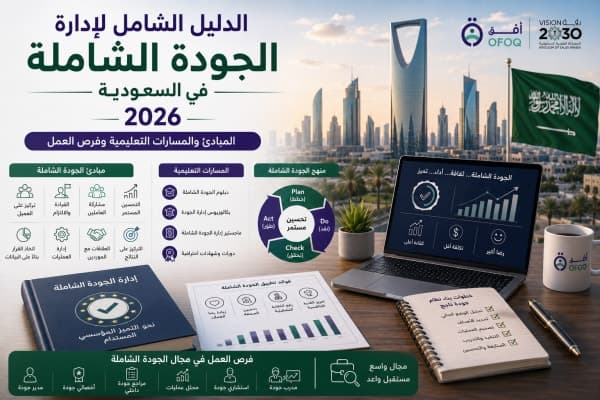
The Complete Guide to Total Quality Management in Saudi Arabia 2026: Principles, Educational Pathways, and Career Opportunities
A comprehensive guide explaining the concept of Total Quality Management (TQM), its importance under Saudi Vision 2030, key principles and tools, educational pathways (diploma, master's, and professional doctorate), and career opportunities and salaries in the Saudi job market.
In the era of digital transformation and global competitiveness, quality is no longer an option or an added advantage — it has become a strategic necessity for any organization seeking excellence and sustainability. In the Kingdom of Saudi Arabia, with the accelerating pace of Vision 2030 implementation, Total Quality Management (TQM) has emerged as one of the fundamental pillars for achieving institutional excellence and enhancing the efficiency of both the public and private sectors [7].
Total Quality Management is not just a set of tools or techniques; it is an integrated management philosophy aimed at achieving continuous improvement in all aspects of the organization, from products and services to internal processes and customer satisfaction. It requires commitment from all management levels, from top leadership to frontline employees [10].
In this comprehensive guide, we explore the concept of Total Quality Management, its core principles, tools and methodologies, educational pathways available in Saudi Arabia (diploma, master's, and professional doctorate), career opportunities and expected salaries, and the promising future of this specialization under Vision 2030.
Total Quality Management (TQM) is an integrated management philosophy aimed at achieving continuous improvement in all aspects of an organization, through a focus on customer satisfaction, employee involvement, and data-driven decision-making [10]. In Saudi Arabia, TQM efforts align with the goals of Vision 2030, which seeks to enhance the efficiency of both public and private sectors and promote institutional excellence [7]. Three main educational pathways are available in this field: the Professional Diploma (22 weeks) [9], the Professional Master's (35 weeks) [8], and the Professional Doctorate, with promising career opportunities and salaries ranging from 8,000 to 30,000 SAR monthly [10]. For more on Ofoq Academy's quality management programs →
📌 Quick Summary: Total Quality Management in Saudi Arabia
- 🎯 Definition: A management philosophy for continuous improvement, customer satisfaction, and institutional excellence [10]
- 🇸🇦 Vision 2030: Quality is a cornerstone for enhancing public and private sector efficiency [7]
- 📚 Educational Pathways: Diploma (22 weeks) [9], Master's (35 weeks) [8], Professional Doctorate
- 💼 Career Opportunities: Quality Manager, Quality Auditor, Quality Engineer, Quality Consultant [10]
- 💰 Salaries: 8,000 - 30,000 SAR monthly depending on experience and position [10]
- 📊 Required Skills: ISO 9001 standards, statistical analysis, leadership, problem-solving [10]
What is Total Quality Management (TQM)?
Total Quality Management (TQM) is an integrated management philosophy aimed at achieving continuous improvement in all aspects of an organization, through a focus on customer satisfaction, employee involvement, and data-driven decision-making [10].
Quality management is a set of processes and systems designed to ensure compliance with institutional standards and acceptable specifications in products and services, and to continuously improve performance within the organization [10]. Quality management includes:
- 🔹 Developing Quality Management Systems – Building frameworks that ensure quality in all processes
- 🔹 Performance Analysis and Measurement – Using data to evaluate performance and identify improvement areas
- 🔹 Internal and External Quality Auditing – Reviewing processes and systems to ensure compliance with standards
- 🔹 Process Improvement and Risk Management – Identifying risks and improving processes to reduce waste and increase efficiency [10]
Total Quality Management differs from traditional quality management in that it is comprehensive, meaning it is not limited to a specific department but extends to all departments and all management levels. It is also proactive, focusing on preventing problems before they occur, rather than addressing them after they happen.
🇸🇦 The Importance of Quality Management in Saudi Arabia and Vision 2030
The field of quality management is one of the key pillars in the success of companies and institutions, especially in the Kingdom of Saudi Arabia, which seeks to enhance its competitiveness locally and globally by improving institutional performance and developing products and services [10]. With the acceleration of national transformation programs and Saudi Vision 2030, the demand for highly competent quality professionals is continuously increasing [10].
The Role of Quality Management in Achieving Vision 2030
- 🏛️ Improving the Efficiency of Government, Educational, and Health Services: Quality management contributes to raising the level of services provided to citizens and residents [10]
- 💰 Reducing Costs and Improving Operational Efficiency: Through waste reduction and productivity improvement [10]
- 🌟 Promoting a Culture of Institutional Excellence and Sustainability: Building organizations capable of competing locally and globally [10]
- 🤝 Increasing Customer Satisfaction: Through improving the quality of products and services [2]
Research indicates that implementing TQM practices significantly improves operational efficiency and enhances corporate social responsibility initiatives, aligning with Saudi Vision 2030 [1]. This structural transformation leads to increased job opportunities in the quality field, especially in high-demand sectors such as oil and gas, education, healthcare, financial services, and the government sector [10].
📋 Core Principles of Total Quality Management
Total Quality Management is based on a set of core principles that form the essence of this management philosophy:
Customer Focus
Customers are the center of all quality efforts. Their needs and expectations must be understood and met, and exceeded [2]
Employee Involvement
Involving all employees in the continuous improvement process and empowering them to contribute their ideas
Continuous Improvement
Constantly striving to improve processes, products, and services, and never being satisfied with the status quo
Data-Driven Decision Making
Relying on facts and data in decision-making, rather than intuition or guesswork
Leadership and Commitment
Top leadership commitment to the quality philosophy, providing necessary resources and support
Process Management
Understanding and managing processes as integrated systems, rather than as separate activities
🛠️ Key Quality Tools and Methodologies
Total Quality Management uses a variety of tools and methodologies to achieve its goals. Key tools include [8][9]:
Seven Quality Tools
Includes: Cause-and-effect diagrams, check sheets, Pareto charts, flowcharts, scatter plots, stratification, and control charts [8]
Continuous Improvement Methodology (PDCA)
The Plan-Do-Check-Act cycle for systematically and continuously improving processes
Statistical Process Control (SPC)
Using statistical methods to monitor and control processes, identifying deviations before they become problems [9]
Root Cause Analysis (RCA)
Identifying the underlying causes of problems rather than treating superficial symptoms
Quality Cost Measurement and Analysis
Identifying and analyzing the Cost of Poor Quality and prevention and evaluation costs [8]
Internal Quality Auditing
Systematic review of processes and systems to ensure compliance with specified standards [9]
📜 International Quality Standards and Excellence Models
Total Quality Management is based on a set of international standards and models that provide a unified framework for implementing quality practices:
ISO 9001:2015
The most famous international standard for quality management systems. Focuses on meeting customer requirements and continuously improving processes [9][4]
European Excellence Model (EFQM)
A comprehensive framework for assessing and improving institutional performance, focusing on nine key excellence criteria [4]
Baldrige Excellence Framework
An American framework for assessing institutional performance, focusing on leadership, strategic planning, and customer focus [4]
Industry-Specific Standards
Specialized standards by sector, such as ISO 13485 for medical devices, IATF 16949 for automotive, and others
These standards and models help organizations evaluate their performance, identify improvement areas, and benchmark against global best practices. They also provide a unified framework for communicating quality requirements with customers, partners, and suppliers.
📚 Educational Pathways: Diploma, Master's, and Professional Doctorate
Several educational pathways in Total Quality Management are available in the Kingdom of Saudi Arabia, catering to different professional and academic stages. Ofoq Academy offers internationally accredited programs in partnership with Cambridge British College in this field [8][9].
Professional Diploma in Total Quality Management
- Duration: 22 weeks [9]
- Target Audience: Quality managers and specialists, engineers, entrepreneurs [9]
- Key Focus Areas: Statistical control tools, continuous improvement methodologies, implementing international quality management systems, preparation for ISO certifications [9]
- Skills Acquired: Applying statistical analysis tools, drafting quality documents, leading improvement teams, internal auditing [9]
Professional Master's in Total Quality Management
- Duration: 35 weeks [8]
- Target Audience: Quality managers and specialists, production engineers, operations managers, professionals in healthcare and services [8]
- Key Focus Areas: Strategic quality planning, leading continuous improvement teams, measuring and analyzing quality costs, designing and managing institutional processes [8]
- Skills Acquired: Applying the seven quality tools, strategic quality planning, leading improvement teams, designing and managing processes [8]
Professional Doctorate in Quality Management
- Duration: 24-36 months
- Target Audience: Senior leaders, consultants, aspiring academics
- Key Focus Areas: Applied research in quality, developing innovative quality frameworks, strategic quality leadership, national quality policies
- Skills Acquired: Thought leadership in quality, designing and implementing quality strategies at the national level, advanced applied research
All these programs are delivered through distance learning, with live lectures, recorded sessions for review, and continuous academic support, allowing employees and professionals to study without interrupting their careers [8][9].
To learn more about available programs at Ofoq Academy, visit the programs page, or check out the Professional Master's in Total Quality Management and the Professional Diploma in Total Quality Management.
💼 Career Opportunities and Salaries in the Saudi Job Market
The Saudi job market is witnessing increasing demand for quality professionals across various sectors. Key job roles in this field include [10]:
Average Salaries in Quality Management in Saudi Arabia (2026)
| Job Title | Monthly Salary Range (SAR) |
|---|---|
| Quality Specialist | 8,000 - 15,000 [10] |
| Internal Quality Auditor | 10,000 - 18,000 [10] |
| Quality Engineer | 12,000 - 20,000 [10] |
| Quality Manager | 18,000 - 30,000 [10] |
Professional experience and certified qualifications are reflected in salary increases, especially in large corporations and multi-branch institutions [10]. The most in-demand sectors for quality professionals include: oil and gas, education, healthcare, financial services, and the government sector [10].
For more on salaries in professional specializations, check out the Guide to Professional Master's Salaries in Saudi Arabia.
🧠 Required Skills and Certifications in Quality Management
To compete effectively in the Saudi job market, possessing the following skills is a significant advantage [10]:
Core Skills
Professional Certifications
Certified qualifications contribute to enhancing job opportunities and promotions within Saudi institutions [10]. Key certifications include:
- 📜 Internal Quality Auditor: A specialized certification in conducting internal audits according to ISO standards [10]
- 🏅 Certified Quality Manager: An advanced certification in leading quality systems [10]
- 📊 Six Sigma Professional: Certifications in process improvement methodologies (Green Belt, Black Belt)
- 📋 ISO-Specific Certifications: Specialized certifications in various ISO standards (ISO 9001, ISO 14001, ISO 45001)
For more on professional certifications, check out the Guide to Best Professional Certifications in Saudi Arabia.
🚀 The Future of Quality Management in Saudi Arabia
With the continued implementation of Vision 2030 and the expansion of major national projects, the field of quality management in Saudi Arabia is expected to see accelerated developments in the coming years:
- 🤖 Integration of Quality with Modern Technologies (TQM 4.0): With increasing reliance on digital technologies, quality frameworks will expand to include digital control systems and AI in process management [1]
- 📊 Data-Driven Quality: Using big data analytics and AI to improve quality processes and decision-making [1]
- 🌍 Integration with Global Standards: Aligning local quality frameworks with global best practices, enhancing the competitiveness of Saudi institutions
- 🏛️ Expanding Quality Application Scope: Quality requirements are expected to cover a wider range of institutions, including SMEs
- 📈 Growing Demand for Specialists: With tightening regulatory requirements and increasing focus on quality, demand for qualified professionals in this field will rise
Forecasts indicate that quality management will remain one of the most in-demand professional fields in the Saudi job market in the coming years, making investment in skills development in this area a strategic decision [10].
To learn about the best professional specializations in Saudi Arabia, check out the Guide to In-Demand Professional Specializations.
Frequently Asked Questions (FAQ)
📌 What is Total Quality Management (TQM)?
Total Quality Management is an integrated management philosophy aimed at achieving continuous improvement in all aspects of the organization, through a focus on customer satisfaction, employee involvement, and data-driven decision-making [10].
📌 Why is quality management important in Saudi Arabia?
It supports Vision 2030 by improving service efficiency, reducing costs, and promoting institutional excellence in both public and private sectors [10][7].
📌 What are the durations of Ofoq Academy's quality management programs?
The Professional Diploma is 22 weeks [9], and the Professional Master's is 35 weeks [8]. Programs are designed to be flexible for employees and professionals.
📌 What are the career opportunities in quality management in Saudi Arabia?
Include: Quality Specialist, Quality Auditor, Quality Engineer, Quality Manager, Quality Consultant, and Compliance Officer. Salaries range from 8,000 to 30,000 SAR monthly [10].
📌 What are the most important skills required in quality management?
Understanding ISO 9001 standards, analytical and problem-solving skills, critical thinking, and effective communication [10].
Ofoq Academy: Your Partner in Professional Excellence in Quality Management
Ofoq Academy is an educational institution specializing in professional master's programs, professional doctorates, and specialized diplomas, in partnership with Cambridge British College. The academy aims to empower Saudi national talent and enhance their competitiveness in the job market, aligned with the targets of Saudi Vision 2030.
The academy offers internationally accredited programs in Total Quality Management, with flexible distance learning and convenient installment plans. Programs include:
- 📜 Professional Diploma in Total Quality Management – 22 weeks [9]
- 🎓 Professional Master's in Total Quality Management – 35 weeks [8]
- 🏛️ Professional Doctorate in Quality Management – 24-36 months
To learn more about available programs, visit the programs page, or check out the Professional Master's program and the Professional Diploma program.
🚀 Are You Ready to Lead Institutional Excellence?
Total Quality Management is the key to institutional excellence in the era of digital transformation and global competitiveness. With growing demand for quality professionals in Saudi Arabia, investing in this field has become a strategic necessity for your professional future.
✉️ Reply within minutes – Free consultation with no obligation
📚 References
- [1] Financial and Market Performance-Driven TQM – MDPI (2026)
- [2] The Role of Digital Management Control Systems on TQM – Frontiers (2026)
- [3] Total Quality Management Program – Prince Sattam University (2026)
- [4] Diploma in Total Quality Management – IBS Academy (2026)
- [5] Total Quality Management: Your Guide to Institutional Excellence – RMG (2025)
- [6] The Role of Total Quality Management in Improving Organizational Performance – AJS (2022)
- [7] Saudi Vision 2030 – An Effective, High-Performing Government
- [8] Professional Master's in Total Quality Management – Ofoq Academy
- [9] Professional Diploma in Total Quality Management – Ofoq Academy
- [10] The Importance of Quality Management in Saudi Arabia and Career Opportunities in 2026 – IBS Academy
- [11] Total Quality Management Program – Prince Sattam University (Career Opportunities)
Frequently Asked Questions
Written by
Academy Team
Expert educator and contributor at Ofoq Academy. Dedicated to sharing insights on leadership and professional development.
Discussion
0 comments
Join the Conversation
Sign in to share your perspective and engage with the Ofoq Academy community.
Sign In to ParticipateFree Consultation
Register your interest and an advisor will contact you