The Complete Guide to Studying EMBA in Saudi Arabia 2026: The Executive Master of Business Administration
A comprehensive guide explaining the Executive Master of Business Administration (EMBA), the difference between EMBA and MBA, accredited programs in Saudi Arabia, admission requirements, salaries, and career opportunities under Vision 2030.
In Saudi Arabia's rapidly changing business landscape, senior managers and executives are increasingly asking: "Is the Executive MBA (EMBA) the right investment for me right now?" [11]
The Kingdom of Saudi Arabia is no longer the same business landscape it was five years ago. Vision 2030 has driven rapid changes across energy, tourism, healthcare, finance, and technology at a pace few predicted [11]. This structural transformation has created a leadership gap: organizations promote capable individuals to senior positions, then expect them to develop comprehensive managerial depth and advanced leadership skills on the job [11]. This is where the EMBA comes in.
In this comprehensive guide, we cover everything you need to know about the EMBA program in Saudi Arabia: the concept, the difference between EMBA and MBA, accredited programs, admission requirements, salaries, and career opportunities.
The Executive Master of Business Administration (EMBA) is a postgraduate program specifically designed for senior leaders and executives with significant experience (8-15 years) in management positions [3]. It differs from the traditional MBA by focusing on strategic leadership, complex decision-making, and change management, with flexibility that allows study while working [0]. In Saudi Arabia, with the accelerating implementation of Vision 2030, demand for EMBA programs is growing steadily, with the executive education market valued at $2.3 billion [5]. Programs feature flexible study formats (weekend sessions or intensive periods) [9] and aim to empower leaders to drive transformation in their organizations [11]. For a comparison with the academic path, see The Difference Between Professional and Academic Master's.
📌 Quick Summary: EMBA in Saudi Arabia
- 🎯 Objective: Develop strategic leadership for senior executives
- 👔 Target Audience: 8-15 years experience in management roles [3]
- ⏳ Duration: 16-24 months (study while working) [1]
- 💰 Salaries: Starting from 45,000 SAR to over 90,000 SAR monthly [2]
- 🏛️ Accreditation: Programs accredited by AACSB, AMBA, NCAAA [6]
- 🇸🇦 Vision 2030: Growing demand for executive leaders across all sectors [5]
What is EMBA?
The Executive Master of Business Administration (EMBA) is a postgraduate program designed specifically for senior managers and executives with extensive practical experience (typically ranging between 8 and 15 years) [3]. It is not a qualification for beginners or those building their career foundations. It is a program built on a fundamentally different premise from the traditional MBA [11].
While the traditional MBA focuses on building broad managerial knowledge across functions, the EMBA program dives deep into strategic decision-making, advanced leadership, and the ability to lead transformation within complex organizations [11]. The program assumes you already understand how business works; its mission is to make you significantly better at leading it [11].
The EMBA is designed to meet the needs of advanced career paths in business administration, through an integrated curriculum that combines theoretical foundations with modern practical applications [8]. EMBA programs typically offer high flexibility, allowing busy executives to continue working while studying [9].
For more on the difference between professional and academic master's degrees in general, see The Difference Between Professional and Academic Master's.
EMBA vs MBA: The Fundamental Difference
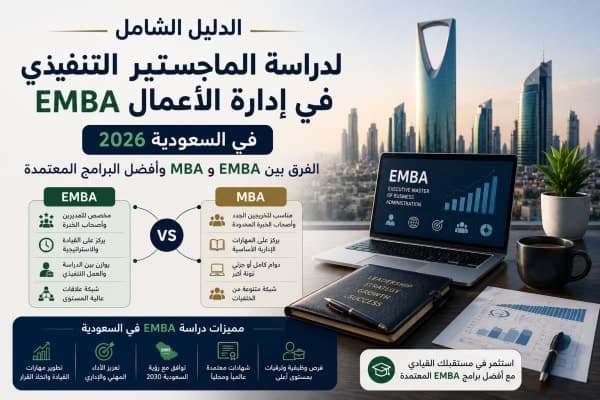
Ambitious professionals often confuse MBA and EMBA. But the difference is fundamental and relates to career stage and study objectives [0]. Here is the comprehensive comparison table:
| Comparison Aspect | EMBA (Executive MBA) | MBA (Master of Business Administration) |
|---|---|---|
| Objective | Strategic leadership, complex decision-making, transformation management [0] | Building broad managerial knowledge, developing core skills [0] |
| Experience Required | 8-15 years, with management experience [3] | 2-5 years [3] |
| Target Audience | Senior managers, executive leaders [0] | Mid-career professionals [0] |
| Study Format | Part-time, weekend sessions or intensive periods [9] | Full-time, evening, or weekend [0] |
| Duration | 16-24 months [1] | 12-24 months (depending on program type) |
| Focus | Direct application to real workplace challenges [11] | Building core management skills |
| Relative Cost | Higher (intensive executive programs) [0] | Medium to high |
Why EMBA in Saudi Arabia Now?
The Kingdom of Saudi Arabia is experiencing one of the world's most ambitious economic transformations [11]. Vision 2030 has fundamentally changed the demands placed on business leaders in both the public and private sectors [11].
Sectors Undergoing Transformation
- Supply Chain Management: Restructuring to build local logistics capabilities and reduce import dependence [11]
- Healthcare: Major expansion with the Kingdom investing in local healthcare delivery and health infrastructure [11]
- Digital Marketing and E-commerce: Accelerating growth as Saudi consumer behavior shifts to digital spaces [11]
- Digital Transformation: Required across public and private institutions, demanding leaders who understand technology strategy [11]
The Leadership Gap in Saudi Organizations
The uncomfortable truth many Saudi professionals acknowledge is that their business environments are changing faster than most internal development programs can keep up [11]. Organizations promote capable individuals to senior positions and then expect them to develop comprehensive managerial depth and advanced leadership skills on the job [11]. This creates a leadership gap that EMBA is designed to fill.
The executive education and leadership market in Saudi Arabia is estimated at $2.3 billion, driven by Vision 2030, digital transformation, and demand for skilled leaders in Riyadh, Jeddah, and Dammam [5].
Top EMBA Programs in Saudi Arabia
Several universities and educational institutions in Saudi Arabia offer accredited EMBA programs, including:
| University / Institution | Program Duration | Accreditation | Notes |
|---|---|---|---|
| King Saud University | Less than 2 years (weekend sessions) [9] | - | Focuses on leadership, results-oriented curriculum, cohort system [9] |
| Al-Rajhi University | 24 months [1] | - | Executive MBA program [4] |
| Saudi Electronic University | 2 years (6 semesters) [7] | - | 36 credit hours, blended learning [7] |
| Princess Nourah University (in partnership with Strathclyde) | Up to 2 years [1] | Triple-accredited [1] | EMBA program from a Business School ranked among the top 1% globally [1] |
| Qassim University | - | AACSB [6] | One of the prominent programs in the Kingdom [6] |
| King Fahd University of Petroleum and Minerals (KFUPM) | - | AMBA [6] | The only school in the Kingdom accredited by AMBA [6] |
For general guidance on choosing accredited programs, see the Guide to Accredited Professional Master's in Saudi Arabia.
Admission Requirements for EMBA Programs
Admission requirements vary by university, but most EMBA programs share the following criteria:
Some universities, like King Saud University, require a cohort system where students enroll, complete courses, and graduate with the same group [9].
What Will You Learn in an EMBA Program?
The EMBA program focuses on developing advanced leadership and strategic skills. Key study areas include:
The EMBA program at Saudi Electronic University requires completion of 36 credit hours distributed across 12 courses [7]. At King Saud University, the program focuses on practical aspects covering a mix of foundational analytical tools and solution-based courses [9].
Salaries and Return on Investment
The EMBA is a strategic investment that yields significant financial returns. Data indicates that EMBA holders in Saudi Arabia receive job offers with salaries starting from 45,000 SAR and exceeding 90,000 SAR monthly [2].
| Job Level | Monthly Salary Range (SAR) |
|---|---|
| Executive (EMBA) | 45,000 - 90,000+ [2] |
| Executives (General) | Average 852,193 SAR annually [2] |
The Hays Saudi Arabia Salary Guide 2026 reports that 62% of organizations increased their headcount in 2025, and 74% plan further growth in 2026 [2], reflecting a thriving business environment that increases the value of leadership qualifications.
Career Opportunities After EMBA
The EMBA program qualifies graduates for senior leadership positions across various sectors [8]:
Top hiring entities include: The Government Sector, Banks and Financial Institutions, Major Consulting Firms, Mega-Projects (NEOM, Red Sea, Qiddiya), and Technology and Telecommunications Companies.
For more on in-demand professional specializations in Saudi Arabia, see the Guide to In-Demand Professional Specializations.
Academic Accreditation: Why It Matters
When choosing an EMBA program, academic accreditation is one of the most important factors ensuring program quality and value in the job market. In Saudi Arabia, several bodies grant program accreditation:
- National Commission for Academic Accreditation and Assessment (NCAAA): Saudi government body that grants accreditation to academic programs in the Kingdom [6]
- AACSB: Prestigious international accreditation, held by Qassim University's EMBA program [6]
- AMBA (Association of MBAs): World-leading accreditation in business education, held by King Fahd University of Petroleum and Minerals as the first and only business school in the Kingdom [6]
- ACBSP: International accreditation held by Fahd bin Sultan University for its EMBA program [6]
Having international accreditation such as AMBA or AACSB means the program meets the highest global standards in business education, increasing the value of your qualification in the local and global job market [6].
Frequently Asked Questions (FAQ)
📌 What is EMBA?
EMBA (Executive MBA) is an executive master's program in business administration designed specifically for senior leaders and executives with extensive experience (8-15 years), focusing on strategic leadership and complex decision-making [3].
📌 What is the difference between MBA and EMBA?
MBA targets early to mid-career professionals (2-5 years experience) and focuses on building core management skills, while EMBA targets executive leaders (8-15 years experience) and focuses on advanced strategic leadership [3]. For more, see The Complete Guide to EMBA.
📌 How long is an EMBA program?
EMBA programs typically range from 16 to 24 months, depending on the program and study format [1]. Most programs are designed to be flexible for busy executives [9].
📌 What are the admission requirements for EMBA?
Typically include: Bachelor's in Business Administration or related field, 8-15 years of management experience, and English proficiency (IELTS 5+ or STEP 76+) [7].
📌 What is the salary of an EMBA holder in Saudi Arabia?
Salaries range from 45,000 to 90,000+ SAR monthly, depending on experience and sector [2].
📌 Is EMBA recognized in the Saudi job market?
Yes, especially if the program is accredited by bodies such as AACSB, AMBA, or NCAAA. EMBA programs are in high demand in Saudi Arabia with the implementation of Vision 2030 [5].
Ofoq Academy: Your Partner in Professional Development
Ofoq Academy is an educational institution specializing in offering professional master's programs, professional doctorates, and specialized diplomas, in partnership with Cambridge British College. The academy aims to empower Saudi national talent and enhance their competitiveness in the job market, in line with the targets of Saudi Vision 2030.
The academy offers internationally accredited programs in administrative and technical specializations such as Business Administration, Project Management, Cybersecurity, Artificial Intelligence, Human Resources, and Governance, with flexibility in distance learning and convenient installment plans.
To learn more about available programs, visit the programs page, or check out the Guide to Accredited Professional Master's, or the Complete Guide to MBA.
🚀 Are You Ready to Lead into the Future?
An EMBA is not just a degree—it is a gateway to strategic leadership in one of the world's fastest-growing economies. In Saudi Arabia's era of transformation, qualified executive leaders are the ones who will shape the future.
✉️ Reply within minutes – Free consultation with no obligation
📚 References
- [0] Boston University Questrom – Executive MBA vs. MBA: Is There a Difference?
- [1] Saudi Electronic University – Executive Master of Business Administration (EMBA) Program
- [2] Best Executive MBA Specializations in Saudi Arabia and Their Salaries – 3rabg
- [3] Cornell University – Executive MBA vs. MBA
- [4] Al-Rajhi University – Executive MBA Program
- [5] Research and Markets – Saudi Arabia Executive Education and Leadership Market
- [6] KFUPM Business School – Assessment & Accreditation
- [7] Saudi Electronic University – Executive Master of Business Administration (EMBA) – Program Overview
- [8] Saudi Electronic University – Executive MBA Program (Arabic version)
- [9] King Saud University – College of Business Administration – Executive MBA (EMBA)
- [10] MBA Today – Best Executive MBA programs in Saudi Arabia 2026
- [11] University of Manchester – Is an Executive MBA in Saudi Arabia worth it?
- [12] The Complete Guide to EMBA vs MBA – Ofoq Academy
- [13] The Complete Guide to Studying MBA in Saudi Arabia – Ofoq Academy
- [14] The Guide to Accredited Professional Master's in Saudi Arabia – Ofoq Academy
Frequently Asked Questions
Related Academic Programs


Written by
Academy Team
Expert educator and contributor at Ofoq Academy. Dedicated to sharing insights on leadership and professional development.
Discussion
0 comments
Join the Conversation
Sign in to share your perspective and engage with the Ofoq Academy community.
Sign In to ParticipateFree Consultation
Register your interest and an advisor will contact you