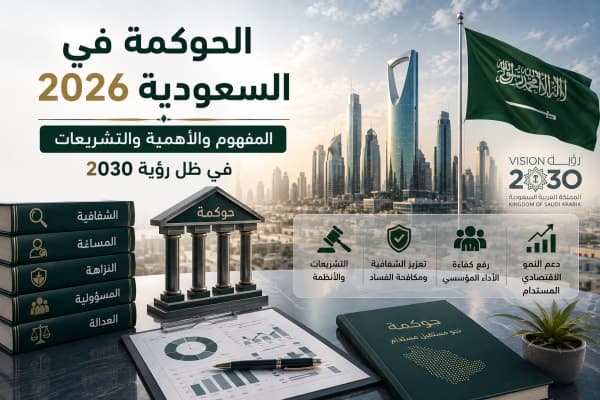
Governance in Saudi Arabia 2026: Concept, Importance, and Future Under Vision 2030
A comprehensive guide explaining the concept of corporate governance, its evolution in the Kingdom of Saudi Arabia, its importance in achieving Vision 2030, with an overview of the latest regulations and Capital Market Authority requirements.
Amid the major economic and administrative transformations in the Kingdom of Saudi Arabia, corporate governance has emerged as one of the fundamental pillars for achieving sustainable development and enhancing transparency and accountability in both the public and private sectors [6].
Governance is no longer just a legal or procedural requirement, but has become a cornerstone of sustainable growth and a strategic driver for enhancing trust and transparency [8]. With the launch of the ambitious Saudi Vision 2030, which aims to diversify the economy and strengthen the Kingdom's position as an investment powerhouse, the importance of implementing best governance practices has multiplied to ensure the achievement of these national and institutional aspirations [8].
In this comprehensive guide, we explore the concept of governance, its evolution in the Kingdom, its importance in achieving Vision 2030, the latest regulations and regulatory requirements, while highlighting the role of governance in enhancing trust and attracting investments.
Corporate governance is an integrated system of policies, procedures, and structures that govern how organizations are managed, directed, and controlled, aiming to achieve transparency, accountability, and efficiency [10]. In Saudi Arabia, governance has seen significant development since the issuance of the first corporate governance regulation in 2006 [5], and today it is a fundamental pillar for achieving Vision 2030, which aims to build an ambitious nation committed to efficiency and responsibility, governed by an effective, high-performing government characterized by transparency and accountability at all levels [6]. For more on studying governance in Saudi Arabia →
📌 Quick Summary: Governance in Saudi Arabia
- 🏛️ Definition: An integrated system of policies and procedures governing organizational management
- 📜 Legislative Evolution: From 2006 to the 2026 Financial Market Institutions Regulation [1]
- 🇸🇦 Vision 2030: Governance as a pillar of transparency, accountability, and efficiency [6]
- 📊 Core Principles: Transparency, accountability, integrity, rule of law, risk management [10]
- 🎯 Importance: Attracting investments, improving performance, achieving sustainability, protecting stakeholder rights [8]
What is Corporate Governance?
Corporate governance is a set of systems, rules, and procedures that guide and regulate the relationships between various stakeholders in an organization, and defines how decisions are made and how powers and responsibilities are distributed across different management levels [11].
Governance primarily aims to achieve transparency and fairness, and to provide the right to hold management accountable, thereby protecting the interests of shareholders and stakeholders while considering the interests of business and society as a whole [11].
Simply put, governance answers the following questions [10]:
- 🔹 Who makes decisions? (Authorities and responsibilities)
- 🔹 How are decisions made? (Processes and procedures)
- 🔹 Who monitors implementation? (Oversight and accountability mechanisms)
- 🔹 How do we ensure results? (Performance measurement and improvement)
To learn about governance study pathways in Saudi Arabia, see the Complete Guide to Studying Governance in Saudi Arabia.
The Evolution of Governance in Saudi Arabia
The Kingdom of Saudi Arabia has witnessed significant development in the field of corporate governance over the past two decades [5]. This evolution can be summarized in the following stages:
The Saudi Governance Center is the first specialized consulting center in the field of governance, risk management, compliance (GRC), and institutional excellence in the Kingdom [5].
Governance and Saudi Vision 2030
Saudi Vision 2030 aims for an ambitious nation, committed to efficiency and responsibility, governed by an effective, high-performing government characterized by transparency and accountability at all levels [6].
Governance contributes directly to achieving the Vision's goals through [0]:
- Improving government performance efficiency: Defining clear and measurable performance indicators, and establishing effective oversight mechanisms [0]
- Enhancing transparency and accountability: Providing information and establishing clear mechanisms for holding officials accountable [10]
- Attracting investments: Building an attractive investment environment through the application of global governance standards [8]
- Achieving sustainable development: Ensuring the sustainability of resources and services through strategic planning and risk management [3]
Studies have shown that the activation of governance has tangibly contributed to enhancing institutional transparency, improving spending efficiency, and developing accountability and preventive oversight mechanisms in the Saudi government sector [7].
Core Principles of Governance
The Importance of Governance in Saudi Arabia
Corporate governance is gaining increasing importance in the Kingdom of Saudi Arabia, especially under Vision 2030, which aims to diversify the economy and enhance transparency and accountability in both the public and private sectors [11]. The importance of governance is evident through [11][8]:
- 💰 Enhancing investor confidence and attracting investments: Good governance contributes to strengthening the confidence of local and foreign investors in the Saudi capital market, helping to attract more investments and revitalize the economy [11]
- 📈 Achieving sustainability and long-term growth: Good corporate governance enables companies to achieve sustainable growth in the long term by improving decision-making processes and effectively managing risks [11]
- ⚖️ Enhancing compliance with regulations: With increasing legislation, governance plays a pivotal role in helping institutions comply with these regulatory requirements and avoid penalties and legal risks [11]
- 📊 Improving operational and financial performance: Effective governance contributes to improving operational efficiency, increasing productivity, and enhancing the financial performance of organizations [11]
- 🤝 Protecting stakeholder rights: Governance ensures balance between the interests of various parties, including shareholders, management, employees, customers, and society [11]
Latest Regulatory Developments (2026)
The year 2026 witnessed important regulatory developments in the field of governance, most notably the adoption of the Financial Market Institutions Regulation 2026 by the Capital Market Authority [1].
Key Amendments in the Financial Market Institutions Regulation 2026 [9]
- 🤖 Robo-Advisor Governance: Establishing regulatory frameworks for the use of algorithms, modern technologies, and artificial intelligence in investment management, requiring institutions to disclose the mechanism of system operation and clarify associated risks [9]
- 📅 License Term Set at 10 Years: With automatic renewal, requiring continued financial solvency and regulatory adequacy [9]
- 🔍 Enhancing Transparency and Conduct Rules: Prohibiting the acceptance of gifts or incentives that influence investment decisions, and requiring institutions to establish written procedures for handling client complaints [9]
- 🛡️ Enhancing AML/CTF Compliance: Requiring institutions to implement anti-money laundering and counter-terrorism financing procedures, and to verify clients before establishing contractual relationships [9]
These amendments reflect the Capital Market Authority's direction towards raising the level of professionalism in the financial market, enhancing corporate governance, protecting investors, regulating the use of financial technologies, and strengthening confidence in the Saudi market [9].
The new Saudi Corporate Governance Code has also been issued, aiming to reduce legal and financial risks by applying global corporate governance standards compatible with the Saudi system [2].
The Saudi Cabinet recently approved an updated state revenue system to enhance governance and improve the efficiency of government revenue management, in line with Vision 2030 reforms [2].
Governance, Risk, and Compliance (GRC)
GRC stands for (Governance, Risk, and Compliance) — an integrated framework that combines governance, risk management, and regulatory compliance into a unified system [5].
GRC represents an evolution of the traditional governance concept, integrating three interconnected elements:
- 🏛️ Governance: Defining the leadership and oversight structure of the organization
- 🛡️ Risk Management: Identifying, assessing, and managing the risks facing the organization
- ⚖️ Compliance: Ensuring the organization's adherence to laws, regulations, and standards
The GRC framework helps organizations balance achieving strategic goals with managing risks and meeting regulatory requirements.
For more on studying GRC in Saudi Arabia, see the Complete Guide to the Professional Master's in Governance.
Governance in the Public Sector
Public sector governance is an integrated system of policies, procedures, structures, and mechanisms that govern the management, direction, and control of government institutions and agencies, aiming to ensure the achievement of public goals with efficiency, transparency, and accountability [10].
Public sector governance differs from private sector governance in its primary objective; while the private sector aims to maximize shareholder profits, the public sector aims to serve society and achieve public interests [10].
Core components of public sector governance include [10]:
- Transparency: Making information and data available clearly and understandably to all stakeholders
- Accountability: Establishing clear mechanisms for holding officials accountable for their decisions and actions
- Government Efficiency: Maximizing the use of available resources
- Institutional Integrity: Ensuring adherence to the highest ethical standards
- Rule of Law: Fair and equal application of laws
- Government Oversight: Multi-level oversight mechanisms
- Risk Management: Identifying, monitoring, and mitigating risks
- Performance Governance: An integrated system for measuring, monitoring, and improving institutional performance
Studies indicate that activating governance in the Saudi government sector has contributed to enhancing institutional transparency and improving spending efficiency, despite some structural challenges related to traditional bureaucracy and resistance to change [7].
Frequently Asked Questions (FAQ)
📌 What is corporate governance?
Corporate governance is a set of systems, rules, and procedures that guide and regulate relationships between various stakeholders in an organization, defining how decisions are made and powers and responsibilities are distributed [11].
📌 Why is governance important in Saudi Arabia?
Governance contributes to enhancing investor confidence, achieving sustainability, enhancing regulatory compliance, improving performance, and protecting stakeholder rights [11]. It is a core pillar for achieving Vision 2030 [6].
📌 What is GRC?
GRC is an integrated framework combining Governance, Risk Management, and Regulatory Compliance into a unified system [5].
📌 What are the key new governance regulations for 2026?
Most notably the Financial Market Institutions Regulation 2026, which enhances governance and transparency, regulates the use of modern technologies, and sets the license term at 10 years [9], along with the new Saudi Corporate Governance Code [2].
📌 How does governance relate to Vision 2030?
Vision 2030 positions governance as a core pillar for achieving transparency, accountability, and efficiency in both public and private sectors, contributing to improved government performance and attracting investments [0].
📌 What is the difference between public and private sector governance?
The private sector's primary objective is maximizing shareholder profits, while the public sector aims to serve society and achieve public interests [10].
Ofoq Academy: Your Partner in Professional Development in Governance
Ofoq Academy is an educational institution specializing in professional master's programs, professional doctorates, and specialized diplomas, in partnership with Cambridge British College. The academy aims to empower Saudi national talent and enhance their competitiveness in the job market, aligned with the targets of Saudi Vision 2030.
The academy offers internationally accredited programs in Governance, Risk, and Compliance (GRC), with flexible distance learning and convenient installment plans.
To learn more about available governance programs, visit the programs page, or check out the Guide to Accredited Professional Master's.
🚀 Are You Ready for the Future?
Governance is not just a theoretical concept but a practical practice that enhances transparency, accountability, and efficiency in organizations. With growing demand for specialists in this field, investing in governance skills development has become a strategic necessity.
✉️ Reply within minutes – Free consultation with no obligation
📚 References
- [0] How Governance Supports Achieving Saudi Vision 2030? – TCG
- [1] CMA Approves Financial Market Institutions Regulation 2026 – RightStride Law
- [2] Saudi Cabinet approves updated state revenue system to boost fiscal governance – Arab News
- [3] Public Sector Governance: Why It Became a Strategic Necessity in 2026? – TCG
- [4] Saudi Vision 2030 – Official Website
- [5] Corporate Governance: Concept and Importance in Saudi Arabia – Wiqayh
- [6] Saudi Vision 2030 – An Ambitious Nation
- [7] The Extent of Governance Activation in the Saudi Government Sector – Journal of Administrative Sciences
- [8] Corporate Governance in Saudi Arabia.. Your Path to Sustainable Growth – Maharat Advisory
- [9] Key Amendments in the Financial Market Institutions Regulation 2026 – RightStride Law
- [10] Public Sector Governance: Core Components – TCG
- [11] The Importance of Corporate Governance in Saudi Arabia – Wiqayh
- [12] The Complete Guide to Studying Governance in Saudi Arabia – Ofoq Academy
- [13] The Complete Guide to the Professional Master's in Governance – Ofoq Academy
Frequently Asked Questions

خبير ومستشار مهني في أكاديمية أفق ، حاصل على درجة الماجستير في إدارة الأعمال من كلية كامبريدج. اعمل حالياً على إعداد وتطوير مساقات مهنية معتمدة دوليا تهدف إلى تمكين الكوادر الوطنية السعودية
Discussion
0 comments
Join the Conversation
Sign in to share your perspective and engage with the Ofoq Academy community.
Sign In to ParticipateFree Consultation
Register your interest and an advisor will contact you