Strategic Integration between Governance, Occupational Safety, and Supply Chains in Saudi Arabia 2026: Your Complete Guide to Institutional Excellence
A comprehensive guide explaining the integrated relationship between Governance, Risk, and Compliance (GRC), Health, Safety, and Environment (HSE), and Supply Chain Management, and the importance of this integration in achieving Saudi Vision 2030, with an overview of career opportunities and required skills in these vital specializations.
In the era of rapid economic and administrative transformations in the Kingdom of Saudi Arabia led by Vision 2030, management and technical specializations no longer operate in isolated silos. Strategic integration between Governance, Risk, and Compliance (GRC), Health, Safety, and Environment (HSE), and Supply Chain Management has become an imperative for building resilient organizations capable of facing challenges and achieving institutional excellence [3].
The modern organization is no longer confined to its four walls; it has become an extended enterprise encompassing suppliers, partners, service providers, and multi-level ecosystems [3]. This expansion creates new challenges in governance, risk management, compliance, safety, and supply chains, making integration between these specializations more important than ever.
In this comprehensive guide, we explore the concept of strategic integration between GRC, HSE, and Supply Chains, its importance in achieving Vision 2030, the required skills, and promising career opportunities in these vital specializations.
Strategic integration between Governance (GRC), Occupational Safety (HSE), and Supply Chains is an integrated management approach aimed at building resilient organizations capable of meeting challenges by linking governance, risk, and compliance frameworks with occupational safety standards and supply chain efficiency [3]. Under Vision 2030, this integration has become a strategic necessity, as the National Industrial Development and Logistics Program (NIDLP) requires unified GRC platforms to monitor supply chain risks and automate supplier compliance [3]. The extension of the "Nitaqat" program to include HSE roles creates strong demand for qualified national talent [6]. Required skills include: risk analysis, regulatory compliance, supply chain management, leadership, and strategic thinking. With the Saudi logistics market growing to $55 billion [5] and an expected annual increase of 13% [5], investing in these specializations has become a strategic bet for the future. Explore professional development programs in these specializations →
📌 Quick Summary: Strategic Integration GRC · HSE · Supply Chain
- 🏛️ Integration: Connecting governance, risk, and compliance with occupational safety and supply chains to build resilient organizations [3]
- 🇸🇦 Vision 2030: NIDLP requires unified GRC platforms to monitor supply chain risks [3]
- 📊 Growth: Saudi logistics market $55 billion, 13% annual growth expected [5]
- 🧠 Required Skills: Risk analysis, compliance, supply chain management, leadership, strategic thinking
- 🎯 Demand: "Nitaqat" program creates strong demand for qualified national HSE talent [6]
- 📜 Certifications: NEBOSH IGC, IOSH, CISSP, CISA, specialized GRC certifications [6]
What is Strategic Integration between GRC, HSE, and Supply Chains?
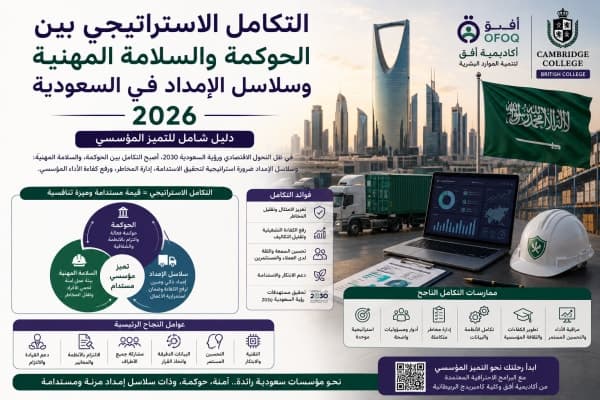
Strategic integration between Governance, Risk, and Compliance (GRC), Health, Safety, and Environment (HSE), and Supply Chain Management is an integrated management approach aimed at building resilient organizations capable of meeting challenges by linking governance, risk, and compliance frameworks with occupational safety standards and supply chain efficiency [3].
In the past, these specializations operated in isolated silos: the governance team focused on compliance, the safety team focused on worker protection, and the supply chain team focused on operational efficiency. Today, with the complexity of the business environment, integration between these specializations has become a necessity to ensure sustainability and success.
GRC (Governance, Risk, Compliance)
An organizational strategy for managing governance and risk while maintaining compliance with industry and government regulations [0]
HSE (Health, Safety, Environment)
An integrated system to ensure the health and safety of workers and protect the environment in workplaces
Supply Chains
Managing the flow of goods, services, and information from suppliers to customers efficiently and effectively
Sources indicate that integration between these specializations has become a necessity under Vision 2030, as the modern organization is no longer confined to its four walls; it has become an extended enterprise encompassing suppliers, partners, service providers, and multi-level ecosystems [3]. This expansion creates new challenges in governance, risk management, compliance, safety, and supply chains.
🇸🇦 Strategic Integration and Saudi Vision 2030
Saudi Vision 2030 places institutional excellence and global competitiveness at the heart of its goals. To achieve these ambitions, the Kingdom launched the National Industrial Development and Logistics Program (NIDLP), which aims to develop integrated industrial supply chains and enhance the Kingdom's position as a global logistics hub [5].
The NIDLP program requires unified GRC platforms to monitor supply chain risks and automate supplier compliance, creating growing demand for specialists with integrated skills in governance, risk management, compliance, and supply chains [3].
Integration Drivers in Vision 2030
- 🏗️ Mega-Projects: Projects like NEOM, the Red Sea, and Qiddiya require advanced governance frameworks, comprehensive risk management, and complex supply chains
- 🤖 Digital Transformation and AI: Automating supply chains and procurement through AI to enhance operational efficiency [5]
- 📈 Logistics Market Growth: The Saudi logistics market exceeds $55 billion, driven by major projects [5]
- 🌍 Regional Integration: Initiatives to enhance logistics integration with GCC countries [5]
- 📜 Regulatory Frameworks: Extension of the "Nitaqat" program to include HSE roles, creating strong demand for qualified national talent [6]
Sources indicate that organizations in Saudi Arabia face challenges in managing third-party and supplier risks, as the modern organization is no longer confined to its four walls [3]. This underscores the need for strategic integration between GRC, HSE, and Supply Chains.
🏛️ Governance, Risk, and Compliance (GRC)
Governance, Risk, and Compliance (GRC) is a comprehensive organizational strategy for managing governance and risk while maintaining compliance with industry and government regulations [0].
Key Components of GRC
- 🏛️ Governance: Defining the leadership and oversight structure of the organization, ensuring transparency and accountability
- 🛡️ Risk Management: Identifying, assessing, and managing the risks facing the organization, including operational, financial, and strategic risks
- ⚖️ Compliance: Ensuring the organization's adherence to relevant laws, regulations, and standards
Sources indicate that GRC is not just a regulatory procedure — it is a force that drives decisions in successful organizations [0]. By integrating governance, risk management, and compliance into a single system, organizations can achieve:
- 📊 Improved Decision-Making: By providing a comprehensive view of risks and opportunities
- 📈 Increased Operational Efficiency: By reducing redundancy and improving processes
- 🤝 Enhanced Trust: By demonstrating commitment to transparency and accountability
- 🌍 Improved Reputation: By proactively managing risks
To learn more about GRC, see the Complete Guide to the Professional Master's in Governance.
🛡️ Occupational Health, Safety, and Environment (HSE)
Health, Safety, and Environment (HSE) is an integrated system of policies, procedures, and practices aimed at protecting the health and safety of workers, preserving the environment, and ensuring a safe and hazard-free work environment.
Importance of HSE in Saudi Arabia
- 🏛️ National Council for Occupational Safety and Health: Established by Cabinet Decision No. 379 to be one of the outputs of the National Strategic Safety Program [1]
- 📈 Growing Demand: The extension of the "Nitaqat" program to include HSE roles creates strong demand for qualified national talent [6]
- 🏗️ Mega-Projects: Projects like NEOM and the Red Sea require stringent safety standards and qualified specialists
- 📜 Regulatory Frameworks: Companies' compliance with ISO 45001 standards and NEBOSH and IOSH certifications [6]
Professional Certifications in HSE
- NEBOSH IGC: The most in-demand certification in the Gulf region, mentioned in OSHAD-SF requirements [6]
- IOSH Managing Safely: A widely recognized certification in safety [6]
- OSHA: Accredited certifications in occupational health and safety [6]
- ISO 45001: An international standard for occupational health and safety management systems [6]
Sources indicate that HSE specialist salaries in Saudi Arabia range between 8,000 and 45,000 SAR monthly, with a notable increase for NEBOSH certification holders [6].
To learn more about HSE, see the Complete Guide to the Professional Master's in HSE.
📦 Supply Chain Management
Supply Chain Management (SCM) is the process of planning, executing, and controlling the flow of goods, services, and information from suppliers to customers efficiently and effectively, aiming to deliver maximum value to customers at the lowest possible cost.
Importance of Supply Chains in Saudi Arabia
- 📈 Market Growth: The Saudi logistics market exceeds $55 billion, with expectations of growth exceeding 13% annually [5]
- 🤖 Digital Transformation: Using AI in Saudi supply chains to shift supplier selection from lowest cost to multi-factor evaluation [5]
- 🏗️ Mega-Projects: Mega-projects create huge demand for logistics and supply chain services
- 🌍 Regional Integration: Initiatives to enhance logistics integration with GCC countries [5]
Future Trends in Supply Chains
- 🤖 AI and Automation: Automating supply chains and procurement through AI to enhance operational efficiency [5]
- 🔄 Resilience and Risk Management: Building resilient supply chains capable of withstanding disruptions and market fluctuations [5]
- 📊 Digital Integration: Using cloud planning systems and control towers to improve visibility and control [5]
- 🌱 Sustainability: Building integrated supply chains through excellence in local content and sustainability [2]
To learn more about supply chain management, see the Complete Guide to Studying Project Management in Saudi Arabia.
🔗 Benefits of Integration Between the Three Specializations
Strategic integration between GRC, HSE, and Supply Chains delivers tangible benefits to organizations:
Comprehensive Risk View
Integrating governance, safety, and supply chain risks into a single system to provide an integrated view of the risks facing the organization
Improved Operational Efficiency
Reducing redundancy and improving processes by unifying frameworks and procedures between different specializations
Integrated Compliance
Ensuring compliance with regulations related to governance, safety, and supply chains through a unified approach
Institutional Resilience
Building organizations capable of adapting to changes and disruptions in the business environment
Enhanced Reputation
Building trust with customers, investors, and regulators by demonstrating commitment to institutional excellence
Better Decision-Making
Providing accurate and comprehensive information that supports strategic decision-making
🧠 Required Skills and Certifications
To compete in the Saudi job market in integrated specializations, professionals must possess a mix of technical and behavioral skills and certified qualifications:
Core Skills
Assessing and managing risks across all specializations
Understanding and applying local and international regulations
Using data to make decisions
Guiding teams and making strategic decisions
Leading organizational transformations
Communicating with various stakeholders
Professional Certifications
| Certification | Awarding Body | Specialization |
|---|---|---|
| NEBOSH IGC | NEBOSH | Occupational Health and Safety [6] |
| IOSH Managing Safely | IOSH | Occupational Health and Safety [6] |
| ISO 45001 Lead Auditor | IRCA | Occupational Health and Safety Management Systems |
| GRC Professional | GRC Institute | Governance, Risk, and Compliance |
| CISSP | ISC² | Cybersecurity and Governance |
| CISA | ISACA | Information Systems Auditing and Control |
| Certified Supply Chain Professional (CSCP) | APICS | Supply Chain Management |
| Certified in Risk and Information Systems Control (CRISC) | ISACA | Risk Management |
To learn more about professional certifications, see the Guide to Best Professional Certifications in Saudi Arabia.
💼 Career Opportunities in Integrated Specializations
The Saudi job market is witnessing increasing demand for specialists in GRC, HSE, and Supply Chains. Key job titles and salary ranges include:
| Job Title | Specialization | Monthly Salary Range (SAR) |
|---|---|---|
| GRC Officer | Governance, Risk, and Compliance | 12,000 - 25,000 |
| HSE Officer | Health, Safety, and Environment | 8,000 - 45,000 [6] |
| HSE Manager | Health, Safety, and Environment | 20,000 - 45,000+ [6] |
| Supply Chain Manager | Supply Chain Management | 18,000 - 35,000 |
| Supply Chain Risk Analyst | Risk Management in Supply Chains | 12,000 - 22,000 |
| GRC Consultant | Governance, Risk, and Compliance | 20,000 - 40,000 |
| Compliance Manager | Regulatory Compliance | 18,000 - 35,000 |
| Procurement and Logistics Manager | Supply Chain Management | 15,000 - 30,000 |
Top employers for these specializations include: Government Sector, Oil and Gas Companies, Mega-Projects (NEOM, Red Sea, Qiddiya), Banks and Financial Institutions, Major Consulting Firms, and Technology and Telecommunications Companies.
To learn more about career opportunities, see the Guide to In-Demand Professional Specializations in Saudi Arabia.
Frequently Asked Questions (FAQ)
📌 What is GRC?
GRC is an organizational strategy for managing governance and risk while maintaining compliance with industry and government regulations [0].
📌 Why is integration between GRC, HSE, and Supply Chains important?
Integration between these specializations provides a comprehensive view of risks, improves operational efficiency, ensures regulatory compliance, and enhances organizational resilience in the face of challenges [3].
📌 What are the most in-demand certifications in HSE in Saudi Arabia?
NEBOSH IGC is the most in-demand certification, followed by IOSH Managing Safely and OSHA certifications [6].
📌 What are the salaries of HSE specialists in Saudi Arabia?
HSE specialist salaries range between 8,000 and 45,000 SAR monthly, depending on experience and qualifications [6].
📌 What is the size of the Saudi logistics market?
The Saudi logistics market exceeds $55 billion, with expectations of growth exceeding 13% annually [5].
📌 How can I start a career in integrated specializations?
You can start by obtaining professional certifications, enrolling in professional master's programs in these specializations, and seeking practical training opportunities in major companies. Visit the programs page to explore available options.
Ofoq Academy: Your Partner in Professional Development in Integrated Specializations
Ofoq Academy for Human Resources Development is an educational institution specializing in professional master's programs, professional doctorates, and specialized diplomas, in partnership with Cambridge British College. The academy aims to empower Saudi national talent and enhance their competitiveness in the job market, aligned with the targets of Saudi Vision 2030.
The academy offers internationally accredited programs in Governance (GRC), Health, Safety, and Environment (HSE), Supply Chain Management, and other vital specializations, with flexible distance learning and convenient installment plans.
To learn more about available programs, visit the programs page, or check out the Complete Guide to Distance Learning at Ofoq Academy.
🚀 Are You Ready to Excel in Integrated Specializations?
Strategic integration between governance, occupational safety, and supply chains is the future of institutional management in Saudi Arabia. With the logistics market growing to $55 billion and increasing demand for national talent, investing in these specializations has become a strategic necessity for your professional future.
✉️ Reply within minutes – Free consultation with no obligation
📚 References
- [0] IBM – What is GRC (Governance, Risk, and Compliance)?
- [1] National Council for Occupational Safety and Health – Official Website
- [2] Saudi Supply Chain and Procurement Conference 2026
- [3] RSM – Manufacturing & Logistics under Vision 2030
- [4] GPRC Summit 2026 – Third-Party & Supplier Risk Management
- [5] Ken Research – Saudi Arabia Supply Chain Management Market Report 2026-2031
- [6] SmartQHSE – Best HSE Certifications for GCC Professionals 2026
Frequently Asked Questions
Related Academic Programs


Written by
Academy Team
Expert educator and contributor at Ofoq Academy. Dedicated to sharing insights on leadership and professional development.
Discussion
0 comments
Join the Conversation
Sign in to share your perspective and engage with the Ofoq Academy community.
Sign In to ParticipateFree Consultation
Register your interest and an advisor will contact you