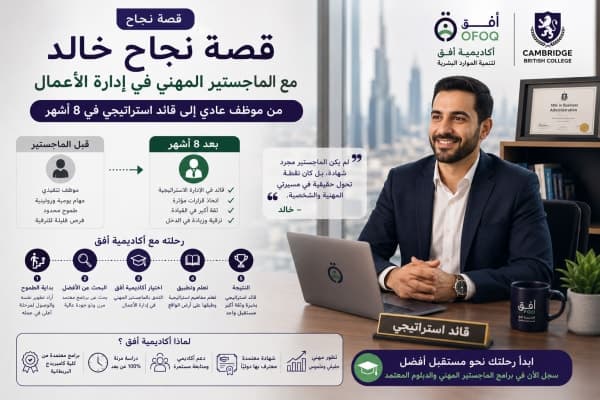
Case Study: Professional Transformation from Financial Analyst to Strategic Leadership Through a Professional Master's in Business Administration
A professional analysis of a Saudi leader's transformation journey, the challenges faced, and the leadership skills acquired through an internationally accredited professional master's program
In Saudi Arabia's rapidly evolving economic landscape, the gap between traditional academic qualifications and modern job market requirements has become more apparent than ever. This case study examines the real professional journey of a Saudi leader who successfully bridged this gap through a professional master's in business administration program, documenting the challenges, outcomes, and key lessons learned.
Case Summary: A Saudi professional (32 years old) in the financial services sector, with 8 years of experience, held the position of "Financial Analyst" at a company listed on the Saudi Stock Exchange (Tadawul).
1. Professional Diagnosis: Gap Analysis
After 8 years in the financial services sector, the professional identified three key gaps that prevented his transition to leadership levels:
Knowledge Gap
Lack of understanding of the overall business picture, with excessive focus on financial details without grasping strategic and operational dimensions.
Leadership Gap
Absence of systematic training in leadership skills, team management, and strategic decision-making in complex work environments.
Institutional Gap
Lack of an internationally recognized academic qualification that provides confidence and credibility in executive circles.
2. Choosing the Path: Decision Criteria
Based on the gap analysis, the professional set precise criteria for selecting the right program:
Cambridge British College
8 months (35 weeks)
100% online — recorded lectures
$1,349 + flexible installments
The choice settled on the Professional Master's in Business Administration program offered by Ofoq Academy in partnership with Cambridge British College — an internationally accredited program specifically designed for working professionals.
3. Learning Experience: Building Leadership Skills
The learning experience spanned 8 months, covering 35 weeks of intensive study combining live lectures, real-world case studies, and applied projects directly related to the professional's field of work.
Strategic Leadership
Developing the ability to analyze competitive environments and build sustainable strategies, with a focus on decision-making under uncertainty.
Advanced Financial Management
Understanding financial statements from an executive perspective, analyzing returns and risks, and evaluating investment opportunities.
Human Resources Management
Designing performance systems, talent management, and building organizational cultures that support innovation and excellence.
Operations and Change Management
Process improvement methodologies, supply chain management, and leading institutional transformation.
The experience was distinguished by three core components:
- Direct Application: Each week, the professional applied what was learned directly in his daily work, reinforcing learning and making it more effective.
- Interaction with Experts: Instructors with practical experience in various sectors provided deep insights into real market challenges.
- Collaborative Learning: Interaction with peers from diverse professional backgrounds enabled experience exchange and building a professional network.
4. Challenges and Mitigation Strategies
The journey was not without challenges, but careful planning and institutional support helped overcome them:
Balancing intensive work hours with study requirements.
Solution: Precise scheduling, allocating 2 hours daily for study.
Some management and finance concepts were new and required time to absorb.
Solution: Leveraging recorded sessions and academic advisor support.
5. Results and Return on Investment
Six months after graduation, the professional recorded significant quantitative and qualitative transformation in his career:
Financial Return
Salary increase of 60% within the first six months after graduation.
Career Progression
Transition from "Financial Analyst" to "Strategic Planning Manager".
Institutional Value
Joining strategic committees within the company and participating in developing growth plans.
| Indicator | Before Program | After Program | Change Rate |
|---|---|---|---|
| Monthly Salary | 12,000 SAR | 19,200 SAR | +60% |
| Job Level | Financial Analyst | Strategic Planning Manager | — |
| Responsibilities | Data Analysis | Strategic Leadership | — |
6. Lessons Learned and Recommendations
From this experience, several key lessons can be drawn for ambitious professionals in the Saudi job market:
Specialization ≠ Leadership
Deep technical expertise alone does not qualify for leadership positions; acquired management and strategic skills are essential.
International Accreditation Opens Doors
Internationally accredited credentials provide immediate credibility in the job market, saving years of waiting.
Learning While Working is More Effective
Direct application of knowledge in the work environment enhances understanding and accelerates professional development.
Professional Network is a Sustainable Asset
Building professional relationships with program peers opens avenues for collaboration and future opportunities.
🎯 Conclusion
This case study confirms that investing in accredited professional education is one of the highest-return investments in the Saudi job market. Through an intensive 8-month program, a Saudi professional was able to:
- Bridge the gap between practical experience and an internationally recognized academic qualification.
- Develop leadership and strategic skills not available in traditional academic paths.
- Achieve significant income growth within a record timeframe.
- Build a professional network with leaders and consultants from various sectors.
The most important takeaway: Professional development is no longer a luxury — it is a strategic necessity for any professional aspiring to leadership positions. With internationally accredited programs available at short durations and reasonable costs, this step is now within everyone's reach.
Written by
Academy Team
Expert educator and contributor at Ofoq Academy. Dedicated to sharing insights on leadership and professional development.
Discussion
0 comments
Join the Conversation
Sign in to share your perspective and engage with the Ofoq Academy community.
Sign In to ParticipateFree Consultation
Register your interest and an advisor will contact you