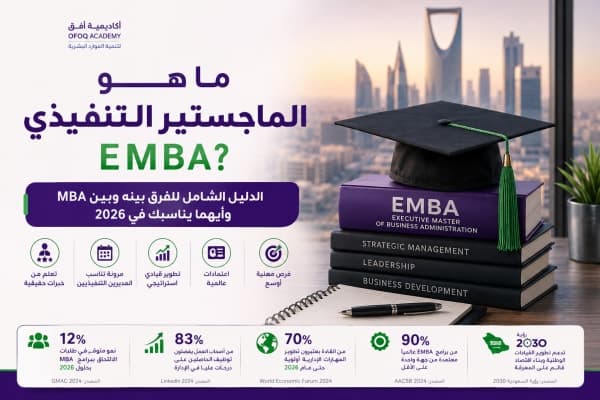
What Is an Executive MBA (EMBA)? The Complete Guide to EMBA vs MBA and Which One Is Right for You in 2026
A clear, practical guide explaining the real difference between the Executive MBA (EMBA) and the traditional MBA, who each program is designed for, and how to make the right decision for your career in the Saudi job market.
With the accelerating economic transformation driven by Saudi Vision 2030, the question "Should I pursue an Executive MBA (EMBA) or a traditional MBA?" has become one of the most common questions asked by ambitious managers and professionals across the Kingdom.
Applicants often confuse the two: some believe the EMBA is a "higher degree" than the MBA. In reality, both degrees are academically equivalent. The essential difference lies in the target audience, the study format, and the focus of the curriculum.
In this guide, you will find a comprehensive comparison to help you choose the program that genuinely serves your career goals, not just the more famous name.
Quick Answer
The Executive MBA (EMBA) is designed for managers and leaders with substantial experience (typically 8+ years) who want to study without leaving their jobs, while the MBA targets professionals in the early or middle stages of their careers who want to build a comprehensive management foundation or change career paths. Both degrees are academically equivalent; the right choice depends on your career stage and where you want to be in the next five years.
Quick Summary
- 🎓 EMBA and MBA are academically equivalent degrees for two different audiences
- 👔 The EMBA is for experienced leaders who study without leaving work
- 🚀 The MBA builds a management foundation or enables a career change
- 🤝 The EMBA network consists of executives and decision-makers
- 📈 Leadership skills rank among the most in-demand skills through 2030
What Is the Executive MBA (EMBA)?
The Executive Master of Business Administration (Executive MBA) is a graduate degree that carries the same academic weight as the MBA, but it is specifically designed for managers and leaders who have accumulated substantial professional experience and want to develop their leadership and strategic capabilities without stepping away from work.
EMBA programs are typically delivered on weekends or in intensive, spaced-out modules, allowing students to balance their leadership roles with their studies. Most importantly, the classroom itself becomes a high-level professional network: sitting next to you are a CFO, an entrepreneur, and a digital transformation leader, making the exchange of experience a core part of the learning.
What Is the Traditional MBA?
The Master of Business Administration (MBA) is the world's best-known degree in management sciences. It typically targets professionals with two to seven years of experience who want to build a comprehensive management foundation, change their career path, or move into their first management roles.
The MBA is offered in multiple formats: full-time, part-time evening, and online. The curriculum focuses on the fundamentals: accounting, marketing, finance, operations management, and organizational behavior, with applied projects that build analytical and decision-making skills from the ground up.
According to the Corporate Recruiters Survey published by the Graduate Management Admission Council (GMAC) in 2024, demand for business school graduates remains strong among companies worldwide.
EMBA vs MBA: The Complete Comparison Table
Before diving into the details, here is the comparison that will save you hours of research:
| Comparison Point | Executive MBA (EMBA) | Traditional MBA |
|---|---|---|
| Required experience | Usually 8–15 years, including leadership roles | Usually 2–7 years |
| Study format | Weekends or intensive modules while working | Full-time, part-time, or online |
| Average student age | Mid-30s to 40s | Late 20s to early 30s |
| Curriculum focus | Strategy, senior leadership, governance, leading transformation | Comprehensive management fundamentals and specializations |
| Career goal | Advancing to senior management and boards | Building or changing a career path |
| Peer network | Executives and sector leaders | Rising professionals from diverse backgrounds |
| Common funding | Sometimes partially or fully sponsored by the employer | Usually self-funded or scholarship-based |
Job Market Numbers to Know Before You Decide
An educational decision is an investment, and smart investing starts with reading the market:
In the Saudi context specifically, Vision 2030 giga-projects and national leadership development targets are creating growing demand for globally qualified Saudi management talent.
The World Economic Forum's Future of Jobs Report 2025 ranks analytical thinking, leadership, and social influence among the most in-demand skills through 2030, and these are precisely what both MBA and EMBA programs are built to develop.
Pros and Cons of Each Program
Executive MBA (EMBA)
✔ Pros
- Continue working and earning while you study
- Immediately apply concepts to your current job challenges
- A network of leaders and decision-makers
- A curriculum focused on strategy and senior leadership
- Potential financial sponsorship from your employer
✖ Challenges
- Significant pressure balancing work, study, and family
- Higher tuition at many prestigious programs
- Fewer specialization options compared to the MBA
- Requires years of experience that not everyone has yet
Traditional MBA
✔ Pros
- A comprehensive management foundation that opens multiple doors
- Flexible study formats: full-time, part-time, or online
- Ideal for changing your career path or industry
- Focused specializations: finance, marketing, analytics, entrepreneurship
✖ Challenges
- Full-time study means a break in income
- Classmates usually have less professional experience
- Return on investment takes longer to materialize
Which One Is Right for You in 2026?
A practical example of choosing the EMBA:
A department director at a Saudi telecom company leads a team of 40 employees and realizes that reaching a Vice President position requires deeper strategic and financial expertise. The EMBA gives her exactly that without leaving her role, and she can apply her course projects directly to her company's real challenges.
A practical example of choosing the MBA:
A software engineer with five years of experience aspires to move into product management. A part-time or online MBA gives him the business, financial, and networking foundation needed for that transition.
Pre-Application Checklist
- ✅ You have clearly written down your five-year career goal
- ✅ You have verified the program's accreditation and official recognition
- ✅ You have compared the average experience of previous cohorts with your own
- ✅ You have discussed sponsorship or schedule flexibility with your employer
- ✅ You have calculated the full cost, including tuition, time, and commitments
- ✅ You have spoken with at least two alumni of your target program
- ✅ You have a realistic plan to balance study, work, and family
Common Mistakes to Avoid Before Choosing
1. Believing the EMBA is a "superior version" of the MBA
They are equivalent degrees for two different audiences; choosing the wrong program for your career stage significantly reduces your return.
2. Ignoring the professional network factor
The quality of your cohort matters as much as the quality of the curriculum, especially in the Saudi market where opportunities are built on trusted professional relationships.
3. Calculating only the financial cost
The real cost includes your time, energy, and family presence; plan for the balance before you start, not after.
4. Neglecting accreditation checks
Always verify academic accreditation and certificate verifiability before paying any fees.
5. Waiting for the "perfect time"
With 39% of core skills changing by 2030 according to the World Economic Forum, the cost of waiting may exceed the cost of starting.
Frequently Asked Questions About the EMBA and MBA
Is the EMBA academically superior to the MBA?
Can I study for an EMBA while working full-time?
How many years of experience do I need to apply for an EMBA?
Which is better for a career change?
Do employers sponsor their employees' EMBA studies?
Ready to Take the Next Step in Your Leadership Journey?
Contact Ofoq Academy's advisors for a free consultation to help you choose the program that best fits your career goals.
Frequently Asked Questions
Related Academic Programs


Written by
فريق التحرير — أكاديمية أفق لتنمية الموارد البشرية
Expert educator and contributor at Ofoq Academy. Dedicated to sharing insights on leadership and professional development.
Discussion
0 comments
Join the Conversation
Sign in to share your perspective and engage with the Ofoq Academy community.
Sign In to ParticipateFree Consultation
Register your interest and an advisor will contact you