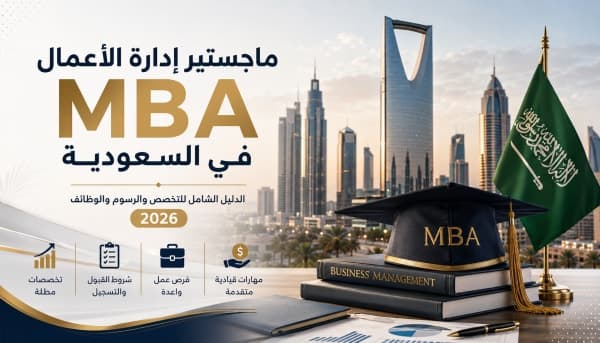
The Complete Guide to Studying an MBA in Saudi Arabia 2026
A comprehensive guide explaining the Master of Business Administration (MBA), the growing demand for it in Saudi Arabia, admission requirements, best specializations, career opportunities, and expected salaries, with practical tips for choosing the right program for your career path.

With the economic expansion in the Kingdom under Saudi Vision 2030, companies and institutions are increasingly seeking professionals capable of leading teams, managing projects, and making strategic decisions, which has made the MBA one of the most valuable qualifications in the Saudi job market [2].
In this comprehensive guide, you will learn everything you need to know about the Master of Business Administration in Saudi Arabia: the concept, benefits, specializations, career opportunities, and expected salaries.
The Master of Business Administration (MBA) is a professional postgraduate program designed to develop managerial and leadership skills, preparing graduates for supervisory and executive positions within organizations [3]. The program focuses on strategic management, leadership, marketing, human resources, financial management, and operations management. The program typically lasts between 12 and 24 months and is considered one of the most flexible programs, allowing professionals to study while working. For more on MBA in Saudi Arabia →
📌 Quick Summary: MBA in Saudi Arabia
- 🎯 Objective: Develop leadership and management skills for professionals
- 👔 Target Audience: Employees, managers, entrepreneurs, aspiring leaders
- ⏳ Duration: 12-24 months (flexible for working professionals)
- 📊 Focus: Leadership, strategy, marketing, finance, human resources
- 💼 Career Outcomes: Project Manager, Executive, Management Consultant, HR Manager
- 🇸🇦 Vision 2030: Growing demand for business leaders across all sectors [2]
What is the Master of Business Administration MBA?
The Master of Business Administration (MBA) is a professional postgraduate program designed to develop managerial and leadership skills, preparing graduates for supervisory and executive positions within organizations [3]. The program focuses on a range of core areas including:
- 🔹 Strategic Management: Long-term planning and building competitive advantage
- 🔹 Leadership: Managing teams, motivating employees, and achieving goals
- 🔹 Marketing: Understanding consumer behavior and developing marketing strategies
- 🔹 Human Resources: Talent acquisition and employee development
- 🔹 Financial Management: Analyzing financial data and making investment decisions
- 🔹 Operations Management: Improving operational efficiency and supply chain management
- 🔹 Entrepreneurship: Launching ventures and managing growth
- 🔹 Project Management: Planning, execution, monitoring, and risk management
It is considered one of the most flexible programs, allowing professionals to study while working.
To understand the difference between MBA and DBA, see the Guide to the Difference Between MBA and DBA.
Why is Demand for MBA Increasing in Saudi Arabia?
In recent years, the Kingdom has witnessed rapid growth across various economic sectors, leading to increased demand for qualified leaders [2]. Key reasons for the rising demand for MBA include:
- 🏛️ Saudi Vision 2030: National transformation projects require professionals capable of managing change, leading teams, strategic planning, and managing major projects [2]
- 📈 Increased Job Market Competition: A bachelor's degree alone is no longer sufficient to reach leadership positions in many sectors
- 🔄 Rapid Job Market Evolution: Organizations seek individuals with advanced practical and managerial skills to achieve institutional goals
- 📊 Higher Promotion Opportunities: MBA holders often receive better promotion opportunities compared to others
For more on in-demand professional specializations, see the Guide to In-Demand Professional Specializations.
What Will You Learn in an MBA Program?
The program focuses on building a wide range of practical skills:
Management Leadership
Managing teams, motivating employees, and achieving goals
Strategic Thinking
Building long-term plans and making critical decisions
Human Resources Management
Talent acquisition and employee development
Marketing & Brand Management
Understanding consumer behavior and developing marketing strategies
Financial Management
Analyzing financial data and making investment decisions
Project Management
Planning, execution, monitoring, and risk management
Best MBA Specializations in Saudi Arabia
MBA specializations vary to cover the needs of leaders across different sectors [4]. Key specializations in demand in the Saudi market include:
For more on the best professional specializations, see the Guide to In-Demand Professional Specializations in Saudi Arabia.
Admission Requirements for MBA Programs
Requirements vary by institution, but common requirements include [5]:
Bachelor's degree in any field
National ID or valid residence
Detailing experience and achievements
Required for some programs
For more on general professional master's admission requirements, see the Guide to Accredited Professional Master's.
The Difference Between MBA and Academic Master's
To understand the difference between the two pathways, here is a comprehensive comparison table [6]:
| Comparison Aspect | MBA (Master of Business Administration) | Academic Master's |
|---|---|---|
| Primary Objective | Professional development and applied leadership skills | In-depth scientific research and preparing researchers |
| Target Audience | Employees, managers, leaders | Graduates seeking teaching or research careers |
| Study Method | Practical application, case studies | Theoretical focus, dissertations, scientific research |
| Typical Duration | 12-24 months | 24-36 months |
| Career Outcome | Promotion, executive positions, increased income | Academic work, pursuing a PhD |
For more on the difference between professional and academic master's, see the Guide to the Difference Between Professional and Academic Master's.
Skills Acquired by MBA Students
An MBA program gives you an integrated set of leadership and management skills. Here are the estimated skill acquisition percentages during the program:
* Estimated percentages reflecting the level of skill acquisition during the program
Career Opportunities After MBA
An MBA opens wide opportunities across various sectors [4]. Key positions include:
For more on professional master's salaries, see the Guide to Professional Master's Salaries.
Does an MBA Increase Salary?
In many cases, an MBA helps with [1]:
- 📈 Increased promotion opportunities: MBA holders get better promotion opportunities compared to others
- 👔 Access to leadership positions: Qualification for senior executive and management roles
- 🏆 Improved competitiveness: A competitive advantage in the job market
- 🤝 Expanded professional network: Building relationships with colleagues from different sectors
- 💰 Better chances for higher-paying jobs: Increased income potential
However, its impact also depends on individual experience, skills, and the sector they work in. An MBA alone does not guarantee an automatic salary increase, but it enhances your opportunities to reach higher-paying positions.
How to Choose the Best MBA Program?
Before enrolling, ask yourself these questions [5]:
Am I aiming for promotion or career change?
Leadership? Marketing? Finance?
Does it offer realistic practical applications?
Accreditation increases the certificate's market value
The more the program aligns with your career goals, the greater the benefit you will gain. For more on academic accreditation, see the Guide to Accredited Professional Master's.
Frequently Asked Questions (FAQ)
📌 What is the Master of Business Administration MBA?
The MBA is a professional postgraduate program designed to develop managerial and leadership skills, preparing graduates for supervisory and executive positions within organizations [3].
📌 How long is an MBA program?
Duration typically ranges from 12 to 24 months, depending on the program and study pace.
📌 What is the difference between MBA and an academic master's?
The MBA focuses on practical application and developing leadership skills, while an academic master's focuses on theoretical research [6]. For more, see the Guide to the Difference Between Professional and Academic Master's.
📌 Does an MBA increase salary?
In many cases, an MBA helps increase promotion opportunities and access to higher-paying jobs, but its impact depends on experience, skills, and sector [1].
📌 What are the best MBA specializations in Saudi Arabia?
Top specializations include: Executive Leadership, Human Resources Management, Marketing, Financial Management, Project Management, and Entrepreneurship [4].
📌 Can I study an MBA while working full-time?
Yes, MBA programs are specifically designed for working professionals, with flexible distance learning, evening, or weekend options [5].
Ofoq Academy: Your Partner in Professional Development
Ofoq Academy is an educational institution specializing in professional master's programs, professional doctorates, and specialized diplomas, in partnership with Cambridge British College. The academy aims to empower Saudi national talent and enhance their competitiveness in the job market, aligned with the targets of Saudi Vision 2030.
The academy offers internationally accredited programs in administrative and technical specializations such as Business Administration, Project Management, Cybersecurity, Artificial Intelligence, Human Resources, and Governance, with flexible distance learning and convenient installment plans.
To learn more about available programs, visit the programs page, or check out the Guide to Accredited Professional Master's.
🚀 Are You Ready to Lead the Future?
The Master of Business Administration MBA is your investment in your leadership future. Choose the right program and begin your journey toward senior executive positions.
✉️ Reply within minutes – Free consultation with no obligation
📚 References
- [1] Payscale – MBA Salary Analysis for Saudi Arabia 2026
- [2] Saudi Vision 2030 – Business Leadership Development
- [3] Project Management Institute (PMI) – Professional Program Standards
- [4] LinkedIn – Most In-Demand Specializations Report for Saudi Arabia 2026
- [5] Guide to Accredited Professional Master's – Ofoq Academy
- [6] Guide to the Difference Between Professional and Academic Master's – Ofoq Academy
- [7] The Complete Guide to MBA in Saudi Arabia – Ofoq Academy
- [8] 12 Reasons Why It's the Best Investment for Your Career – Ofoq Academy
Frequently Asked Questions
Related Academic Programs

Written by
Academy Team
Expert educator and contributor at Ofoq Academy. Dedicated to sharing insights on leadership and professional development.
Discussion
0 comments
Join the Conversation
Sign in to share your perspective and engage with the Ofoq Academy community.
Sign In to ParticipateFree Consultation
Register your interest and an advisor will contact you