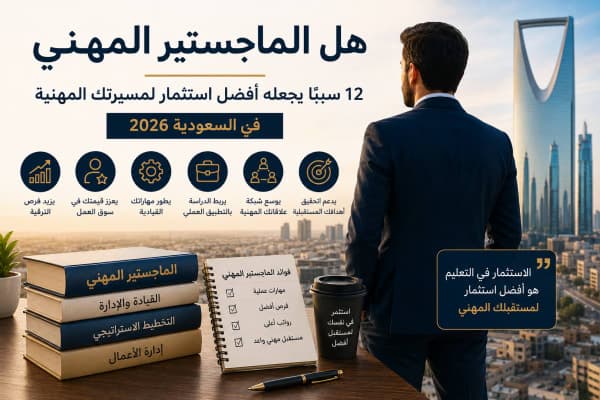
Is a Professional Master's Worth It? 12 Reasons Why It's the Best Investment for Your Career in Saudi Arabia 2026
A comprehensive guide based on actual labor market indicators, helping you determine if a Professional Master's degree is a step worth your time and money.
If you are considering pursuing a Professional Master's degree, it is likely that this question has crossed your mind more than once: Is a Professional Master's worth the time, money, and effort?
This question has become one of the most widespread among employees, graduates, and business owners in the Kingdom of Saudi Arabia, especially with the major developments the labor market is witnessing, the expansion of national projects, and the increasing competition for leadership positions.
Today, obtaining a university degree is no longer sufficient to reach senior management positions. Companies are looking for individuals who possess practical skills, leadership capabilities, and a strategic vision that helps them lead teams, make decisions, and achieve results.
For this reason, the Professional Master's has become one of the most in-demand postgraduate programs in Saudi Arabia, because it combines academic knowledge with practical application, giving learners real tools that can be used directly within the workplace environment.
💡 Quick Answer:
Yes, a Professional Master's degree is worth the investment for most ambitious employees, because it combines leadership skills, practical application, and expanding your professional network. However, its true value depends on choosing the right program for your career goal and your level of commitment to actually applying what you learn within your workplace environment.In this guide, we will review with numbers and facts 12 reasons that make a Professional Master's one of the best career investments in 2026, along with the most important mistakes many people make before registering, and how to choose the right program to achieve your career goals.
📊 Quick Glance in Numbers: Why is the Labor Market Changing So Fast?
Before diving into the details, here are real indicators from trusted sources showing the scale of transformation the Saudi and global labor market is witnessing, and why leadership qualifications have become a decisive factor in job competition:
of the skills used in most jobs are expected to change by 2030 due to artificial intelligence and technical transformation.
LinkedIn Work Change Report 2025of employees worldwide will need reskilling due to rapid technological transformation.
World Economic Forum (WEF), via PwC reportof learning and development leaders in organizations confirm that leadership and human skills have become more valuable than ever.
LinkedIn Workplace Learning Report 2025of hiring managers observe a clear gap between the skills candidates possess and what companies actually need.
LinkedIn Labor Market Data 2025labor force participation rate in Saudi Arabia during the first quarter of 2025.
Ministry of Human Resources and Social Developmentparticipation rate of Saudi women in the labor market, compared to only 17% in 2017 — exceeding the Saudi Vision 2030 target.
Ministry of Human Resources and Social DevelopmentSaudi male and female employees were supported to join the private sector during the first quarter of 2025 alone.
Human Resources Development Fund (HADAF)share of non-oil activities in the Kingdom's real GDP, driven by economic diversification.
Saudi Vision 2030 ReportsA Quick Look at the Saudi Labor Market
The Kingdom of Saudi Arabia is witnessing an unprecedented economic transformation within the objectives of Saudi Vision 2030, which has directly reflected on employment requirements inside government and private institutions.
Today, companies are looking for employees who possess more than just experience; they need leaders capable of:
- Leading work teams
- Project management
- Strategic decision-making
- Change management
- Improving organizational performance
- Achieving growth and sustainability
Therefore, the demand for professional qualifications that help develop these skills in a practical manner has risen.
🔎 Did You Know?
According to the LinkedIn Work Change report, it is expected that 70% of the skills used in most jobs will change by 2030 — which makes leadership and analytical skills more important than ever, not just traditional technical experience.
Indicators Reflecting Labor Market Development
| Indicator | Impact on Employees |
|---|---|
| Expansion of Vision 2030 projects | Increased demand for administrative leadership |
| Digital transformation in organizations | Need for modern skills |
| Private sector growth | Greater competition for jobs |
| Increase in foreign investments | Higher hiring standards |
| Expansion of global companies | Greater demand for professional competencies |
Why Are Employers Today Looking for Leaders, Not Just Employees?
The question companies ask is no longer "Do you have enough years of experience?" Instead, it has become closer to: "Can you lead a team, solve complex problems, and make impactful decisions?"
Therefore, the value of the following specializations and skills is continuously rising within the Saudi market:
- Leadership: The ability to motivate teams and direct them toward clear goals.
- Strategic Thinking: A comprehensive vision that goes beyond daily tasks.
- Project Management: Delivering initiatives and projects within the specified time and budget.
- Human Resources: Managing human capital as a strategic asset, not just administrative affairs.
- Business Administration: A comprehensive understanding of financial, marketing, and operational processes.
- Certified Professional Qualifications: Objective evidence of seriousness and readiness to assume greater responsibilities.
🎓 Expert Opinion
LinkedIn reports indicate that 62% of hiring managers observe a clear gap between the skills candidates possess and what companies actually need. Professional Master's programs are one of the tools to bridge this gap practically and directly.
Why Has a Professional Master's Become a Smart Choice?
Years ago, many believed that obtaining a bachelor's degree was enough to build a successful career. Today, the equation has completely changed.
Organizations no longer hire people based on the degree alone; instead, they look at their ability to manage teams, solve problems, lead projects, think strategically, and develop the work environment.
This is where the role of the Professional Master's comes in, focusing on developing these skills through practical cases, applied projects, and tools that can be used directly in the work environment.
Reason One: It Doubles Career Promotion Opportunities
One of the biggest reasons driving employees to study a Professional Master's is the desire to reach supervisory and leadership positions.
Many organizations have come to prefer employees with advanced qualifications because they see in them a greater capacity to bear responsibility, manage teams, and make decisions.
When you combine practical experience with the leadership skills acquired during the program, your chances of competing for leadership jobs become much higher compared to those who possess experience alone.
A Professional Master's helps you to:
- Improve your professional profile
- Build a leadership personality
- Develop management skills
- Gain the confidence of decision-makers
- Increase promotion opportunities within the organization
Reason Two: It Gives You a Competitive Advantage in the Labor Market
The Saudi labor market is witnessing increasing competition year after year, especially with the entry of global companies and new investments into various sectors.
In a competitive environment like this, it is not enough to possess years of experience alone; you need what distinguishes you from the rest of the applicants.
A Professional Master's gives you this advantage by developing your skills in leadership, planning, change management, and teamwork — skills that have become required in most management positions.
Comparison Between a Traditional Employee and a Professional Master's Holder
| Traditional Employee | Professional Master's Holder |
|---|---|
| Relies on experience only | Combines experience with applied knowledge |
| Focuses on executing tasks | Participates in decision-making |
| Slower promotion opportunities | Higher promotion opportunities |
| Limited leadership skills | Possesses modern leadership tools |
| Faces difficulty in competing | Enjoys a clear competitive advantage |
Compass Career Advice
If you plan to reach a managerial position within the next 3 to 5 years, investing in developing your skills today might be the factor that makes the difference when a promotion opportunity appears.
Reason Three: It Helps You Acquire Leadership Skills Needed by the Labor Market
In the past, companies relied heavily on technical experience when choosing managers. Today, leadership skills have become one of the most important criteria for hiring and promotion.
A successful leader's role is not limited to distributing tasks; rather, they have the ability to motivate the team, manage time and resources, make decisions under pressure, resolve conflicts, and achieve strategic goals.
For this reason, Professional Master's programs focus on developing these skills through case studies, practical simulations, and applied projects.
Most Important Leadership Skills Acquired by the Learner
| Skill | Importance in the Work Environment |
|---|---|
| Leadership | Managing teams and achieving goals |
| Communication | Improving cooperation between departments |
| Decision-Making | Speed in addressing problems |
| Time Management | Raising productivity |
| Strategic Thinking | Long-term planning |
| Change Management | Leading transformation within the organization |
🎓 Expert Opinion
LinkedIn Workplace Learning reports confirm that 91% of learning and development professionals believe that leadership and human skills have become more valuable than ever — even with the acceleration of AI tools.
Reason Four: It is Suitable for Employees and Does Not Require Leaving Work
One of the features that make a Professional Master's a preferred option is that it is designed specifically to suit employees.
Most professional programs provide flexible lectures, remote or hybrid study, the possibility of balancing work and study, and practical applications linked to the current job.
Thus, the employee can develop themselves without the need to pause their career path or lose their source of income.
💡 Important Tip
Many learners apply what they learn directly within work, which reflects on their job performance even before obtaining the degree itself.
Reason Five: It Links Studies to Practical Reality
One of the most prominent differences between a Professional Master's and traditional academic programs is that the educational content is not limited to the theoretical side.
Instead, it relies heavily on real problems from the labor market, global case studies, practical applications, group projects, and simulations of work environments.
This makes the learning process more effective, because the learner gains practical experience they can benefit from from day one.
🔎 Did You Know?
Many employment reports indicate that employers prefer candidates capable of applying knowledge practically over those who possess theoretical knowledge only, especially in administrative and leadership jobs.
Reason Six: It Expands Your Professional Network
One of the biggest advantages that many learners overlook is building a strong professional network (Professional Network).
During your studies, you will often meet managers, entrepreneurs, company owners, employees from different sectors, experts, and consultants.
This diversity gives you an opportunity to exchange experiences, learn about new job opportunities, and build relationships that may open doors you did not expect.
Reason Seven: It Develops Your Decision-Making Ability
The higher you rise on the career ladder, the more impactful the decisions you make become on the organization.
Therefore, a Professional Master's focuses on developing skills such as data analysis, risk assessment, studying alternatives, critical thinking, and making decisions based on evidence, instead of relying on intuition or experience alone.
How Does the Decision-Making Method Develop?
| Before Study | After Study |
|---|---|
| Relying on personal experience | Using modern analysis tools |
| Short-term decisions | Long-term strategic vision |
| Addressing problems after they occur | Predicting risks before they happen |
| Traditional solutions | Innovative solutions based on analysis |
Reason Eight: It Qualifies You for Managerial and Leadership Positions
Most leadership positions do not only require years of experience; they also need qualifications that prove you possess the necessary skills to manage organizations and teams.
Among the most prominent positions that a Professional Master's can support you to reach:
- Department Manager / Project Manager
- HR Manager / Business Development Manager
- Operations Manager / Quality Manager
- Strategic Manager / Executive Manager
- Management Consultant
What Are Employers Looking for Today?
Instead of the question "Do you have a degree?", the question has become closer to: "Can you lead the team and achieve results?" For this reason, companies focus on candidates who combine practical experience, professional qualifications, leadership skills, strategic thinking, and problem-solving ability.
Reason Nine: It Helps You Increase Your Income in the Long Run
One of the most frequently asked questions by those wishing to study a Professional Master's is: Does a Professional Master's help increase the salary?
The realistic answer is that the degree alone does not guarantee an increase in income, but obtaining an advanced professional qualification, along with experience and skills, may increase the chances of accessing jobs with higher responsibilities and salaries.
In the Saudi labor market, salaries depend on several factors, including:
- Years of experience
- The sector you work in
- The size of the organization
- Leadership skills
- Professional qualifications
- Job performance
How Does a Professional Master's Affect Your Career Path?
| Before Study | After Acquiring Professional Skills |
|---|---|
| Executing daily tasks | Participating in decision-making |
| Limited promotion opportunities | Greater opportunities for leadership positions |
| Operational responsibilities | Strategic responsibilities |
| High competition | Stronger competitive advantage |
| Slow professional growth | Faster opportunities for career development |
⚠️ Avoid This Mistake
Do not assume that any Master's program will automatically raise your salary. The true financial return comes from applying what you learn and linking it to tangible performance, not from the degree as a paper hung on the wall.
Reason Ten: It Aligns with the Needs of Saudi Vision 2030
The Kingdom is witnessing a major economic transformation in sectors such as technology, investment, energy, health, education, tourism, logistics, and the non-profit sector.
With this transformation, organizations have begun looking for leaders who possess the ability to manage projects, lead work teams, execute strategic plans, improve performance, innovate, and manage change — all of which are skills that represent a core focus in Professional Master's programs.
🎓 Expert Opinion
The labor market is no longer looking only for the employee who performs their tasks efficiently, but rather for the person capable of leading change and achieving sustainable results that support the promising objectives of Saudi Vision 2030.
Reason Eleven: A Long-term Investment in Yourself
When buying a new car or phone, their value begins to decrease over time. As for investing in education and developing skills, it is one of the investments that can continue to achieve a return throughout your professional life.
A Professional Master's does not only grant you a degree; it also helps you improve your way of thinking, develop leadership skills, increase self-confidence, build a professional network, and acquire modern tools for management.
All these acquisitions remain with you even when changing jobs or moving to another sector entirely.
Reason Twelve: It Gives You a Competitive Advantage Hard to Replicate
In a labor market that includes thousands of applicants for the same job, the question becomes: What makes you different?
Many may possess the same years of experience, but only a few combine practical experience, professional qualification, strategic thinking, leadership skills, the ability to manage teams, and an understanding of the latest management practices.
Herein lies the true value of a Professional Master's: a rare combination that is difficult for any competitor to replicate quickly.
💹 Return on Investment (ROI): How Do You Measure the Value of a Professional Master's?
The value of a Professional Master's cannot be reduced to salary alone. To understand the true return, it is helpful to look at it from multiple angles:
| Type of Return | What Does It Mean? |
|---|---|
| Career ROI | Your ability to compete for broader roles and responsibilities that were not previously available to you. |
| Skills ROI | Acquiring leadership, analysis, and decision-making tools that you can use in any job or sector in the future. |
| Promotion ROI | Increasing the likelihood of being viewed as a candidate ready for a supervisory or managerial position when the opportunity becomes available. |
| Salary Potential | The degree does not guarantee an automatic salary increase, but it may increase your competitiveness for roles with higher responsibilities and salaries, alongside experience and performance. |
| Leadership ROI | A tangible development in the ability to manage teams, motivate them, and make decisions under pressure. |
| Networking ROI | A network of relationships with managers, experts, and classmates, which may later turn into job opportunities or partnerships. |
| Long-term Value | Skills, confidence, and tools that remain with you even when changing jobs or moving to an entirely new sector. |
💡 Important Tip
Treat a Professional Master's as an integrated package of returns (skills, relationships, confidence, opportunities), not as a bet on a single salary number. This perspective makes the study decision more realistic and less prone to disappointment.
🗺️ Career Roadmap: How Continuous Learning Supports Each Stage
Career development usually goes through successive stages, and continuous learning (diploma, then a Professional Master's, then a Professional Doctorate when needed) plays a different role in each stage:
University Graduate
The beginning of the career path, focusing on acquiring the first practical experience.
Junior Employee
Executing tasks, building the professional foundation, while beginning to identify the desired specialization.
Team Leader
A professional diploma or short leadership courses begin to support the transition to this stage.
Department Manager
A Professional Master's (such as an MBA) becomes a primary support for transitioning to managerial roles.
Executive Director
Strategic leadership and change management skills become more important than daily execution.
General Manager / Vice President
Programs like a Professional Doctorate (DBA) support the capacity for broad strategic impact.
Chief Executive Officer (CEO)
A combination of long experience, continuous learning, and a strong network of relationships built over years.
Top 5 Mistakes Applicants Make Before Registering
Before you invest your time and money in any program, avoid these common mistakes:
1. Choosing a Program Based on Price Only
The cheapest program may seem like a good option at first glance, but the true value lies in the quality of the content, the experience of the instructors, and how relevant the program is to your actual career goals.
2. Not Defining a Career Goal Before Registering
Ask yourself clearly: Do I want a promotion? Do I want to change my field? Am I targeting a leadership position? Answering these questions determines the most suitable program for you.
3. Ignoring a Detailed Review of the Program Content
Not all programs are the same. Review the courses, the skills acquired, the proportion of the practical aspect, and the applied projects before making a decision.
4. Not Verifying the Awarding Body and Its Reputation
Choose an educational institution with a reliable reputation that provides professional content that keeps pace with the actual needs of the Saudi labor market, not just a formal certificate.
5. Believing That the Certificate Alone is Enough
True professional success depends on continuous learning, practical experience, and actually applying what you learn within your work environment — not on the certificate as a paper only.
How to Choose the Right Professional Master's Program?
🧭 A Practical 5-Step Framework for Choosing the Right Program
- Define your career goal precisely: promotion, career change, or a leadership position?
- Review the program content, courses, and the skills actually acquired.
- Verify the accreditation and reputation of the awarding body in the Saudi labor market.
- Compare the flexibility of the study (remote, hybrid, evening) with your job commitments.
- Ask about the percentage of the applied side and real projects within the program.
Before registering, use this simple template to make an informed decision:
| Question | Yes | No |
|---|---|---|
| Does the program serve my career goals? | ☐ | ☐ |
| Does it focus on practical application? | ☐ | ☐ |
| Does it suit my time and circumstances? | ☐ | ☐ |
| Does it help me acquire leadership skills? | ☐ | ☐ |
| Is it compatible with my current specialization? | ☐ | ☐ |
| Can I apply what I will learn in my work? | ☐ | ☐ |
✓ Is a Professional Master's Right for You?
A Professional Master's may be a suitable option if you are:
- An employee wishing for a promotion
- A team leader seeking to develop your skills
- A manager who wants to improve institutional performance
- A project owner seeking to grow their business
- A graduate who wants to enhance their opportunities in the labor market
- Planning to assume greater responsibilities in the coming years
Most Important Advantages Provided by a Professional Master's
- Developing leadership skills
- Enhancing promotion opportunities
- Improving decision-making ability
- Acquiring applicable practical experiences
- Expanding professional networks
- Raising the ability to compete
- Supporting career development
- Keeping pace with the needs of the Saudi labor market
Quick Summary
| What Will You Get? | The Benefit |
|---|---|
| Leadership skills | Managing teams efficiently |
| Applied knowledge | Solving real problems |
| Network of relationships | New professional opportunities |
| Practical experiences | Direct application at work |
| Competitive advantage | Better opportunities in recruitment and promotion |
🔑 Key Takeaways to Remember from This Guide
- A Professional Master's is not just an additional degree; it is a tool for building leadership and decision-making skills.
- The Saudi labor market is changing rapidly, and most global and local indicators confirm the high demand for leadership skills.
- The degree alone does not guarantee a promotion or a salary increase, but it significantly increases your competitiveness.
- Combining practical experience with a professional qualification gives you an advantage that is hard for others to replicate.
- Choosing the right program is more important than choosing any program randomly or based on price only.
- The professional network built during your studies can be just as important as the degree itself.
- Continuous learning supports every stage of the career path, from graduation to senior executive positions.
- The best time to invest in developing yourself is before you need the opportunity, not after it appears.
🚦 Next Steps
- Define your career goal clearly over the next three to five years.
- Identify the skills you need to develop to reach this goal.
- Compare available programs in terms of content, flexibility, and practical application.
- Verify the quality and accreditation of the program's awarding body.
- Submit your application and start your actual step toward professional development.
Conclusion
Professional success no longer depends only on years of experience or obtaining a university degree; rather, it has become linked to your ability for continuous learning, developing your skills, and preparing for changing labor market requirements.
A Professional Master's represents a real opportunity to build a stronger career path, by combining modern knowledge with practical application, and developing skills in leadership, management, and decision-making.
With the continuous economic development in the Kingdom of Saudi Arabia and the increasing demand for competencies capable of leading organizations and projects, investing in developing yourself may be one of the most important decisions you make for your professional future.
Are you ready to take the next step?
If you are looking for a Professional Master's program that helps you develop your leadership skills, enhance your promotion opportunities, and build a more distinguished career, start first by defining your goals, then compare the available programs, and choose what adds true value to your journey. Remember: the best time to invest in your professional future is when you start preparing for it, not when the opportunity suddenly becomes available.
Explore Available Programs NowFrequently Asked Questions
Related Academic Programs

Academic Program
Executive Doctorate in Business Administration — DBA

Academic Program
Professional Master of Business Administration

Academic Program
Professional Master in Project & Risk Management

Academic Program
Professional Master in Human Resources Management

Academic Program
Professional Master in Public Relations & Marketing

Academic Program
Professional Master in Supply Chain & Logistics Management
Written by
Academy Team
Expert educator and contributor at Ofoq Academy. Dedicated to sharing insights on leadership and professional development.
Discussion
0 comments
Join the Conversation
Sign in to share your perspective and engage with the Ofoq Academy community.
Sign In to ParticipateFree Consultation
Register your interest and an advisor will contact you