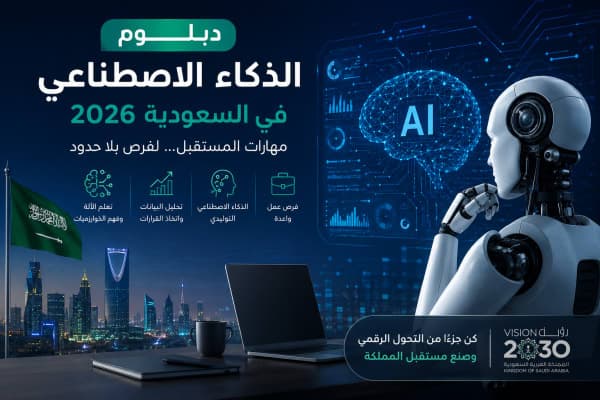
Artificial Intelligence (AI) is no longer just a futuristic technology; it has become one of the most critical drivers reshaping the labor market in the Kingdom of Saudi Arabia and globally. With the accelerating pace of digital transformation and the increasing reliance of both public and private organizations on AI technologies, the demand for professionals who understand and can apply these tools across various sectors has skyrocketed.
For this reason, an AI Diploma has emerged as one of the most attractive professional programs for employees, graduates, and entrepreneurs seeking to upscale their skills and keep pace with modern market requirements.
In this comprehensive guide, you will explore the concept of an AI diploma, the core skills it focuses on, admission requirements, career opportunities, average salaries in Saudi Arabia, and how to choose the right program to achieve your professional goals.
📌 Table of Contents
- 1. Why is AI Among the Most Important Fields in Saudi Arabia?
- 2. What is an Artificial Intelligence Diploma?
- 3. What Will You Learn in an AI Diploma?
- 4. Who is the AI Diploma For?
- 5. Why Choose to Study AI Right Now?
- 6. Admission Requirements for an AI Diploma
- 7. Core Skills You Will Gain from an AI Diploma
- 8. Essential AI Tools to Learn
- 9. Career Opportunities After Earning an AI Diploma
- 10. Average Salaries for AI Jobs in Saudi Arabia
- 11. AI Diploma vs. Bachelor's vs. Master's Degree
- 12. How to Choose the Best AI Diploma in Saudi Arabia?
- 13. Common Mistakes When Choosing an AI Diploma
- 14. Why is Continuous Learning Crucial in AI?
- 15. How an AI Diploma Supports Your Career Path
- 16. Why is the Demand for Professional AI Programs Growing?
1. Why is AI Among the Most Important Fields in Saudi Arabia?
Saudi Arabia is witnessing a massive digital transformation driven by Saudi Vision 2030 initiatives, where AI has become a core element in developing government services, healthcare, education, financial services, energy, manufacturing, and cybersecurity.
Furthermore, the Saudi Data and AI Authority (SDAIA) is leading numerous national initiatives aimed at elevating the Kingdom's position as a global leader in data and AI.
PwC reports indicate that AI could add approximately $320 billion to the Middle East economy by 2030, with Saudi Arabia expected to capture the largest share of this value due to massive investments in digital transformation and innovation.
💡 Key Fact: According to the LinkedIn Jobs on the Rise report and World Economic Forum data, AI, data analysis, and machine learning roles are among the fastest-growing occupations globally.
2. What is an Artificial Intelligence Diploma?
An AI Diploma is a professional program designed to equip learners with the foundational knowledge and practical skills needed to understand AI technologies and their workplace applications, without the extensive academic depth required by Bachelor's or Master's degrees.
This type of program prioritizes practical application over theoretical concepts, enabling learners to use AI tools to boost productivity, analyze data, automate processes, and support decision-making.
3. What Will You Learn in an AI Diploma?
While curricula may vary by institution, most professional programs cover key topics tailored to meet modern job market and SEO requirements:
| Module | What You Will Learn |
|---|---|
| Introduction to AI | Core concepts and the historical evolution of artificial intelligence. |
| Machine Learning | Understanding how models are trained and data is analyzed. |
| Data Analytics | Leveraging data to drive informed decision-making. |
| Generative AI | Exploring tools like ChatGPT and content generation techniques. |
| Prompt Engineering | Crafting effective prompts to maximize output quality from AI models. |
| AI Ethics | Responsible utilization, governance, and risk management. |
| AI Applications in Business | Applying AI across HR, marketing, management, and healthcare. |
4. Who is the AI Diploma For?
This program is ideal for diverse groups seeking professional advancement, including:
- Employees looking to enhance their digital capabilities.
- Managers and team leaders aiming to integrate AI into executive operations.
- Entrepreneurs wanting to optimize business efficiency.
- University graduates searching for high-demand market skills.
- Professionals working in HR, marketing, finance, and data analysis.
- Small and medium enterprise (SME) owners looking to boost productivity through smart tools.
5. Why Choose to Study AI Right Now?
Several factors make this specialization highly appealing today:
- Surging demand for verified digital proficiencies.
- Widespread adoption of AI across traditional industries.
- Strong government support for digital infrastructure and innovation.
- The universal need for cross-functional employees capable of managing smart workflows.
Possessing a practical grasp of AI serves as a powerful competitive advantage, even in non-technical roles, as organizations increasingly depend on automation to improve performance.
6. Admission Requirements for an AI Diploma
While prerequisites vary by institution, most professional programs offer flexible criteria to welcome a broad range of learners.
📋 Common Admission Checklist:
- High school diploma or higher qualification (based on provider criteria).
- Basic computer literacy and internet navigation skills.
- A strong drive to develop technical and digital capabilities.
- Commitment to attending lectures and fulfilling practical deliverables.
A background in computer science is rarely required, as these programs are custom-tailored for cross-industry professionals.
📌 Ofoq Insight: Before registering, verify the nature of the curriculum—ensure it highlights hands-on case studies that can be immediately deployed in the workplace.
7. Core Skills You Will Gain from an AI Diploma
The curriculum emphasizes building actionable skills to keep pace with institutional digital evolution:
- Analytical Thinking: Learn to break down data to extract actionable operational insights.
- AI Tools Mastery: Familiarize yourself with top-tier AI software to scale up output quality.
- Task Automation: Understand how to offload repetitive tasks to minimize human errors and time.
- Problem Solving: Apply smart workflows to diagnose bottlenecks and propose data-backed remedies.
- Strategic Decision-Making: Leverage data metrics to steer corporate and operational decisions.
8. Essential AI Tools to Learn
Because the tech landscape evolves rapidly, getting familiar with these prominent cross-sector tools is vital:
| Tool | Application |
|---|---|
| ChatGPT | Content creation, research assistance, and productivity enhancement. |
| Microsoft Copilot | Office automation and advanced spreadsheet analytics. |
| Google Gemini | Research facilitation, ideation, and data processing. |
| Claude AI | Long-form reporting, document analysis, and professional writing. |
| Notion AI | Knowledge management and agile project organization. |
| Power BI (with AI features) | Advanced data visualization and interactive dashboard creation. |
| Generative Image Tools | Designing collateral, marketing visuals, and interactive slide decks. |
ℹ️ Note: You do not need to be a developer to utilize these tools; they are crafted to optimize everyday workflows for all professionals.
9. Career Opportunities After Earning an AI Diploma
As AI integrates into core business infrastructures, certified graduates can pursue diverse high-impact vacancies such as:
- Assistant Data Analyst
- Digital Transformation Coordinator
- Process Automation Specialist
- AI Solutions Support Specialist
- AI Business Development Specialist
- Innovation and Technical Transformation Lead
- Assistant Tech Project Manager
- Corporate AI Utilization Consultant
10. Average Salaries for AI Jobs in Saudi Arabia
Compensation tiers are flexible and highly contingent on your academic background, experience, sector type (public vs. private), and corporate scale.
According to regional employment indicators from LinkedIn, Michael Page, and Hays Middle East, data-centric and smart automation careers yield competitive earnings that scale upward with experience:
| Career Level | Estimated Monthly Salary Range |
|---|---|
| Entry-Level | 8,000 – 14,000 SAR |
| Mid-Career | 15,000 – 25,000 SAR |
| Senior / Team Lead | 25,000 SAR and above |
⚠️ Important Disclaimer: These figures are benchmark estimations derived from published labor marketplace surveys and may fluctuate. A credential alone does not guarantee a locked salary; rather, it elevates your market competitiveness and capability profile.
11. AI Diploma vs. Bachelor's vs. Master's Degree
| Feature | Professional Diploma | Bachelor's Degree | Master's Degree |
|---|---|---|---|
| Primary Goal | Actionable skill acquisition | Broad academic foundation | Advanced research & specialization |
| Duration | Short & flexible | Multiple years | 1 to 2 years typically |
| Target Audience | Employees & graduates | Undergraduate students | Mid-to-senior professionals |
| Market Alignment | ✅ High | ✅ High | ✅ High (sector specific) |
12. How to Choose the Best AI Diploma in Saudi Arabia?
To ensure a high return on your educational investment, evaluate potential programs using these specific criteria:
- Provider Reputability: Opt for established academies recognized for designing industry-relevant training programs.
- Modern Curriculum Content: Ensure coverage of bleeding-edge tracks like Generative AI, Prompt Engineering, and technical ethics.
- Structural Flexibility: Prioritize distance learning formats with recorded archives that mesh well with full-time careers.
- Academic Support: Choose programs backed by dedicated administrative teams to guide you through your learning journey.
13. Common Mistakes When Choosing an AI Diploma
Avoid these frequent oversights to maximize your educational outcomes:
- ❌ Filtering strictly by price: Low cost shouldn't compromise curriculum updates, mentor expertise, and institutional value.
- ❌ Believing AI is strictly for programmers: AI tools have cross-functional applications across marketing, management, HR, and finance.
- ❌ Expecting immediate magic formulas: The diploma establishes your baseline; true career acceleration depends on persistent application.
14. Why is Continuous Learning Crucial in AI?
The tech landscape shifts rapidly; new apps and systems hit the market regularly, meaning learning shouldn't stop at graduation. Staying updated with changing tech developments ensures you retain your competitive edge and help your organization thrive.
15. How an AI Diploma Supports Your Career Path
Earning an AI credential empowers you with highly sought-after capabilities, such as:
- Advanced capacity for parsing data metrics to support execution strategies.
- Enhanced individual throughput via smart workplace tools.
- Active readiness to guide digital transformation initiatives internally.
16. Why is the Demand for Professional AI Programs Growing?
Professionals prefer specialized programs because they strip away excessive theories, focusing entirely on skills ready for workplace integration.
At Ofoq Academy for Human Resources Development, we provide flexible professional tracks through an advanced e-learning ecosystem. Learners enjoy live virtual lectures, on-demand playback archives, ongoing academic tracking, and structured payment plans split into up to 6 installments with zero hidden fees—allowing professionals to balance career advancement with their personal obligations.
Conclusion
AI has fundamentally integrated into the modern business landscape, evolving far beyond a developer-only niche. As digital development reshapes Saudi Arabia, companies require professionals who understand how to apply these smart tools effectively.
An AI Diploma is an excellent gateway to future-proofing your career path for 2026 and beyond. Prioritizing programs that balance robust material with structural flexibility will prepare you to lead confidently in the digital economy.
Frequently Asked Questions
Related Academic Programs

Written by
Moosa Amsabh
Expert educator and contributor at Ofoq Academy. Dedicated to sharing insights on leadership and professional development.
Discussion
0 comments
Join the Conversation
Sign in to share your perspective and engage with the Ofoq Academy community.
Sign In to ParticipateFree Consultation
Register your interest and an advisor will contact you