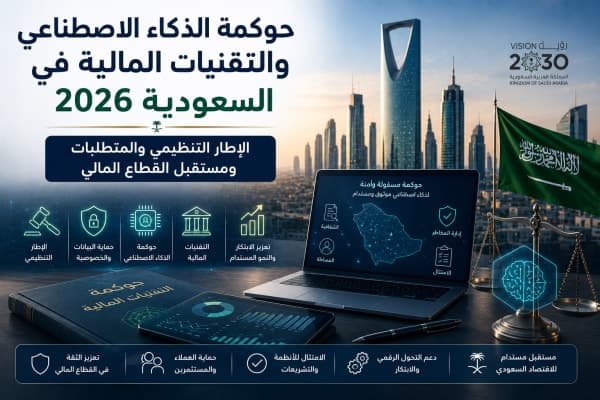
AI and Fintech Governance in Saudi Arabia 2026: Regulatory Framework, Requirements, and the Future of the Financial Sector
A comprehensive guide exploring the regulatory framework for AI governance in Saudi Arabia's financial sector, the latest regulations from the Capital Market Authority and the Central Bank, regulatory requirements for financial institutions, and an analysis of the future of fintech under Vision 2030.
In the era of accelerating digital transformation, Artificial Intelligence and Financial Technology (Fintech) have become key drivers of development in the Kingdom of Saudi Arabia's financial sector. With increasing reliance on these technologies, AI governance has emerged as a fundamental pillar to ensure the responsible and safe use of these technologies, protect investors, and enhance trust in the financial market [12].
AI governance is no longer just an ethical principle or recommendation but has become a mandatory regulatory requirement imposed by supervisory authorities in the Kingdom, led by the Saudi Data and Artificial Intelligence Authority (SDAIA), the Capital Market Authority (CMA), and the Saudi Central Bank (SAMA). These authorities emphasize that AI must fall within the purview of the Board of Directors, not merely a file referred to the IT department [1].
In this comprehensive guide, we explore the regulatory framework for AI and fintech governance in Saudi Arabia, the latest regulations issued by supervisory authorities, regulatory requirements for financial institutions, and the future of this vital sector under Vision 2030.
AI governance in Saudi Arabia's financial sector is an integrated system of policies, procedures, and regulatory frameworks that ensure the responsible and safe use of AI technologies in financial institutions [13]. The core governance principles include: transparency, accountability, fairness, safety, privacy, and human oversight [13]. Financial institutions in Saudi Arabia are subject to a three-tier regulatory framework: SDAIA (AI ethical principles), the Capital Market Authority (robo-advisory services regulation), and Saudi Central Bank (SAMA) (AI governance in financial services) [10][12]. In March 2026, the CMA adopted the Robo-Advisory Services Regulation, requiring financial institutions to establish supervisory systems, conduct periodic algorithm testing, and disclose their mechanisms of operation and associated risks [8]. For more on corporate governance in Saudi Arabia →
📌 Quick Summary: AI Governance in Saudi Arabia's Financial Sector
- 🤖 Definition: An integrated system ensuring responsible and safe use of AI in the financial sector
- 🏛️ Regulatory Bodies: SDAIA (ethical principles), CMA (robo-advisory regulation), SAMA (financial services governance), NCA (cybersecurity) [10]
- 📜 Key 2026 Regulations: Robo-Advisory Services Regulation (March 2026), Financial Market Institutions Regulation 2026 [8]
- 📊 Core Principles: Transparency, accountability, fairness, safety, privacy, human oversight [13]
- 🎯 Importance: Investor protection, market confidence, enabling responsible innovation, achieving Vision 2030 [12]
- 📈 Growth Forecast: 16.6% CAGR, $2.8 billion market by 2031 [3]
What is AI Governance in the Financial Sector?
AI governance in the financial sector is a set of policies, procedures, and regulatory frameworks that ensure the responsible and safe use of AI technologies in financial institutions [13]. This governance aims to:
- 🔹 Ensure transparency: Understanding how AI models make decisions [12]
- 🔹 Enhance accountability: Establishing clear responsibility for decisions made by AI systems [13]
- 🔹 Ensure fairness: Avoiding bias and discrimination in algorithms and data [13]
- 🔹 Protect privacy: Complying with personal data protection laws [12]
- 🔹 Ensure safety: Continuously testing and monitoring AI systems [12]
- 🔹 Human oversight: Establishing clear paths for human intervention in high-risk decisions [12]
Saudi regulators emphasize that AI must fall within the Board of Directors' purview, not merely a file referred to the IT department [1]. The regulatory framework treats AI as a strategic decision no less important than expansion decisions, capital management, or adopting new financial products [1].
To understand the broader importance of corporate governance, see the Complete Guide to Governance in Saudi Arabia.
The Regulatory Landscape: Key Bodies and Their Roles
The regulatory framework for AI governance in Saudi Arabia's financial sector comprises several integrated regulatory bodies [10]: AI deployment in Saudi Arabia is not one compliance conversation but three intersecting conversations [10].
| Regulatory Body | Role | Scope |
|---|---|---|
| Saudi Data and AI Authority (SDAIA) | Establishes ethical principles and regulatory frameworks for responsible AI use across all sectors [10][13] | All sectors (the common foundation) |
| Capital Market Authority (CMA) | Regulates robo-advisory services and sets disclosure and algorithm oversight requirements for capital market institutions [8] | Licensed capital market institutions |
| Saudi Central Bank (SAMA) | Focuses on AI governance in financial services, including banks, fintech companies, and payment service providers [12] | Banks, fintech companies, payment service providers |
| National Cybersecurity Authority (NCA) | Applies Essential Cybersecurity Controls (ECC) to AI systems classified as national critical infrastructure [10] | National critical infrastructure |
The biggest challenge is that institutions treat these requirements as separate workstreams when they are actually one integrated system [10]. The practical approach is to build an AI governance foundation on SDAIA ethics and ISO 42001, then map AI systems against NCA controls, and finally add SAMA requirements for any AI that touches financial products or customer data [10].
Robo-Advisory Services Regulation 2026
In a move reflecting the Kingdom's commitment to developing the investment environment and enhancing regulatory frameworks for fintech, the CMA Board approved on 5 March 2026 amendments to the Financial Market Institutions Regulation, including the regulation of robo-advisory services [8][9].
The amendments aim to enhance market efficiency and expand the range of financial services offered through modern technologies, providing innovative and effective solutions for investors, and opening new investment channels suited to different segments, especially individual investors [9].
Key Regulatory Requirements [8][9]
Prior Notice of Strategies
Requiring capital market institutions to notify the CMA in advance of strategies used in building and managing investment portfolios and any updates thereto [9]
Supervisory Systems and Controls
Establishing supervisory systems and procedures to ensure the safety and efficiency of algorithms and technologies used [9]
Periodic Testing
Conducting periodic tests to ensure the reliability and effectiveness of technologies, at least ten days before making them available to clients [9]
Disclosure Standards
Disclosing details and mechanisms of the robo-advisory service, including portfolio construction strategies, asset selection criteria, and rebalancing rules [9]
IT Officer Registration
Registering the IT officer responsible for managing and supervising the technology systems used [8]
Performance Disclosure
Disclosing the performance record of investment portfolios since inception, including performance benchmarks and total returns after deducting actual expenses [8]
The amendments also allow capital market institutions licensed to conduct investment management to offer robo-advisory services, provided that portfolio investments are not concentrated in a single asset or securities of a single issuer [9]. If the service is offered on securities issued or listed outside the Kingdom, those securities must be subject to the supervision of a regulatory body with comparable standards [9].
The Role of SAMA in AI Governance
The Saudi Central Bank (SAMA) plays a pivotal role in AI governance in the financial sector, focusing on AI-powered financial services in banks, fintech companies, and payment service providers [10][12].
Key Requirements from SAMA [12]
- Explainability of Decisions: Banks and fintech companies must maintain the explainability of AI-powered decisions, especially in credit scoring, fraud detection, and customer profiling [12]
- Third-Party Risk Management: Managing risks associated with AI technology suppliers [12]
- Integration with Cybersecurity Framework: Integrating AI governance within SAMA's cybersecurity framework, covering risk management, governance structures, and operational resilience of AI-powered financial services [10]
The Governor of SAMA noted that the rapid integration of AI across financial systems underscores the need for robust governance, transparency, and accountability to mitigate systemic operational risks [3]. He also emphasized the importance of aligning innovation with regulation, ensuring that market developments do not outpace regulatory readiness [3].
In March 2026, SAMA granted the first Open Banking licenses to fintech companies, marking the transition from pilot testing to mainstream regulated services [3].
To learn more about the role of governance in the financial sector, see the Complete Guide to the Professional Master's in Governance.
SDAIA's AI Ethical Principles
The Saudi Data and Artificial Intelligence Authority (SDAIA) is the national reference for data and AI in the Kingdom, establishing ethical principles and regulatory frameworks for responsible AI use across all sectors [10][13].
The AI Ethical Principles issued by SDAIA consist of six core principles [13]:
- 👁️ Transparency: Understanding how AI systems make decisions
- ⚖️ Accountability: Establishing clear responsibility for decisions made by AI systems
- 🤝 Fairness: Avoiding bias and discrimination in algorithms and data
- 🛡️ Safety: Continuously testing and monitoring AI systems
- 🔒 Privacy: Complying with personal data protection laws
- 👤 Human Oversight: Establishing clear paths for human intervention in high-risk decisions
Key requirements for AI governance under the SDAIA framework include [0]:
- Written frameworks and policies governing responsible AI use [0]
- Establishing a dedicated governance unit with clear mandates and authorities [0]
- Systems for regulatory compliance, reliability, and safety assurance [11]
The SDAIA AI Ethics Framework is the official framework for responsible AI, defining AI ethics as values, principles, and techniques that guide ethical behavior in developing and using AI technologies [5].
The Role of the National Cybersecurity Authority (NCA)
The National Cybersecurity Authority (NCA) is responsible for protecting national critical infrastructure in the Kingdom and applies the Essential Cybersecurity Controls (ECC) to AI systems classified as national critical infrastructure [10][12].
NCA requirements for AI systems include [12]:
- Secure Development: Applying secure development practices to AI systems
- Access Control: Ensuring access control to AI systems and data
- Logging and Monitoring: Activity logging and monitoring of AI systems
- Incident Response: Having incident response plans for AI-related incidents
AI systems can be classified as critical infrastructure based on their use and impact, meaning that MLOps environments, model pipelines, and AI APIs all fall within NCA scope [10].
For more on cybersecurity in Saudi Arabia, see the Complete Guide to Cybersecurity in Saudi Arabia.
Key Regulatory Requirements for Financial Institutions
Based on the regulatory frameworks issued by supervisory authorities, key requirements for financial institutions in Saudi Arabia can be summarized as follows [12]:
Algorithmic Transparency
Clear explanation of how AI models arrive at their outcomes – "black box" systems are increasingly unacceptable [12]
Human Oversight
Clear escalation path from automated decisions to human review for high-risk decisions (credit, hiring, compliance) [12]
Data Governance
Maintaining data lineage, quality controls, and protection measures, including compliance with Saudi personal data protection laws [12]
Continuous Monitoring
Continuous model validation, performance monitoring, and retraining protocols – AI models can drift over time [12]
Vendor Risk Management
Institutions are accountable for the security, compliance, and governance practices of their AI suppliers [12]
Growth and Opportunities: The Future of AI in Saudi Arabia's Financial Sector
The AI market in Saudi Arabia's financial sector is experiencing rapid growth, driven by Vision 2030 and significant investments in digital transformation. The AI in Finance market in Saudi Arabia is projected to grow at a CAGR of 16.6%, reaching $2.8 billion by 2031, up from $1.3 billion in 2026 [3].
Key Growth Drivers [3]
- 🏛️ Vision 2030: Accelerating digital transformation and economic diversification
- 🤖 Year of AI 2026: Designating 2026 as the "Year of AI" by the Council of Ministers in March 2026, reflecting the Kingdom's commitment to accelerating the adoption of advanced technologies [4]
- 🏦 Open Banking: Granting the first open banking licenses in March 2026, opening new avenues for innovation [3]
- 🧪 FinTech Lab: A regulatory sandbox allowing companies to experiment with AI solutions under controlled conditions [3]
- 📈 Increasing Demand for Digital Financial Services: Growing adoption by individual investors of digital solutions
The AI Ethical Principles play a pivotal role in enabling this growth by providing the regulatory framework that ensures responsible AI use and enhances confidence in the financial market [13]. AI ethics is as much a market access issue as it is a policy issue [13].
Practical Steps for AI Governance Compliance
To ensure compliance with AI governance regulatory requirements, compliance and risk leaders can take the following practical steps [12]:
Create an AI Inventory
Document every AI system, its purpose, data sources, vendor, and risk level [12]
Map Regulatory Requirements
Build a compliance matrix mapping controls to SAMA, NCA, CST, and CMA requirements [12]
Model Validation and Monitoring
Regularly test for accuracy, bias, and drift, and define triggers for human review and retraining [12]
Update the Risk Framework
Add AI-specific risk categories such as algorithmic bias, explainability failures, and vendor lock-in [12]
Train Teams
Equip compliance, legal, and internal audit teams with the skills needed to assess AI governance [12]
Regulators are expected to issue more detailed rules on AI auditing, certification of high-risk AI systems, and cross-border data considerations [12]. Institutions that invest now in robust AI governance will avoid penalties and build trust with customers, partners, and regulators [12].
For more on in-demand professional specializations in Saudi Arabia, see the Guide to In-Demand Professional Specializations.
Frequently Asked Questions (FAQ)
📌 What is AI governance in the financial sector?
AI governance in the financial sector is a set of policies, procedures, and regulatory frameworks that ensure the responsible and safe use of AI technologies in financial institutions [13].
📌 Which regulatory bodies are responsible for AI governance in Saudi Arabia's financial sector?
The key bodies are: SDAIA (ethical principles), the Capital Market Authority (robo-advisory regulation), SAMA (financial services governance), and the National Cybersecurity Authority NCA (cybersecurity) [10][12].
📌 What are the key CMA amendments for 2026?
On 5 March 2026, the CMA adopted the Robo-Advisory Services Regulation, including prior notice of strategies, periodic algorithm testing, and disclosure of mechanisms and risks [8][9].
📌 What are SDAIA's AI ethical principles?
They include six principles: transparency, accountability, fairness, safety, privacy, and human oversight [13].
📌 What is the size of the AI market in Saudi Arabia's financial sector?
The market is projected to grow at 16.6% CAGR, reaching $2.8 billion by 2031 [3].
📌 What are the practical steps for AI governance compliance?
They include: creating an AI inventory, mapping regulatory requirements, validating models, updating the risk framework, and training teams [12].
Ofoq Academy: Your Partner in Professional Development in Governance and Fintech
Ofoq Academy is an educational institution specializing in professional master's programs, professional doctorates, and specialized diplomas, in partnership with Cambridge British College. The academy aims to empower Saudi national talent and enhance their competitiveness in the job market, aligned with the targets of Saudi Vision 2030.
The academy offers internationally accredited programs in Governance, Risk, and Compliance (GRC), with flexible distance learning and convenient installment plans.
To learn more about available programs, visit the programs page, or check out the Guide to Accredited Professional Master's.
🚀 Are You Ready for the Future of AI in Finance?
AI governance is not just a regulatory requirement but a fundamental pillar for building investor confidence and enabling responsible innovation in the financial sector. With growing demand for professionals in this field, investing in AI governance and fintech skills development has become a strategic necessity.
✉️ Reply within minutes – Free consultation with no obligation
📚 References
- [1] AI in Islamic Banks – Ammon News (2026)
- [2] From Data to Inference: Why AI Governance Matters – Findev Gateway (2026)
- [3] Saudi Arabia AI in Finance Market – Research and Markets (2026)
- [4] Year of AI 2026 – SDAIA
- [5] Saudi AI Ethics Principles – Vision 2030
- [6] Capital Market Authority – Official Website
- [7] Saudi Central Bank – Official Website
- [8] CMA Approves the Regulation of Robo-Advisory Services – CMA (March 2026)
- [9] CMA Approves Robo-Advisory Services Regulation – CMA (March 2026) (Arabic)
- [10] Navigating SDAIA, NCA, and SAMA in Saudi Arabia AI Governance – LinkedIn (2026)
- [11] AI Governance in Saudi Arabia – RMG (2026)
- [12] How Saudi Regulators Are Shaping the Future of Compliance – BeTop (2026)
- [13] Saudi AI Ethics Principles – Vision 2030
- [14] Complete Guide to Governance in Saudi Arabia – Ofoq Academy
- [15] Complete Guide to the Professional Master's in Governance – Ofoq Academy
Frequently Asked Questions
Related Academic Programs


خبير ومستشار مهني في أكاديمية أفق ، حاصل على درجة الماجستير في إدارة الأعمال من كلية كامبريدج. اعمل حالياً على إعداد وتطوير مساقات مهنية معتمدة دوليا تهدف إلى تمكين الكوادر الوطنية السعودية
Discussion
0 comments
Join the Conversation
Sign in to share your perspective and engage with the Ofoq Academy community.
Sign In to ParticipateFree Consultation
Register your interest and an advisor will contact you